
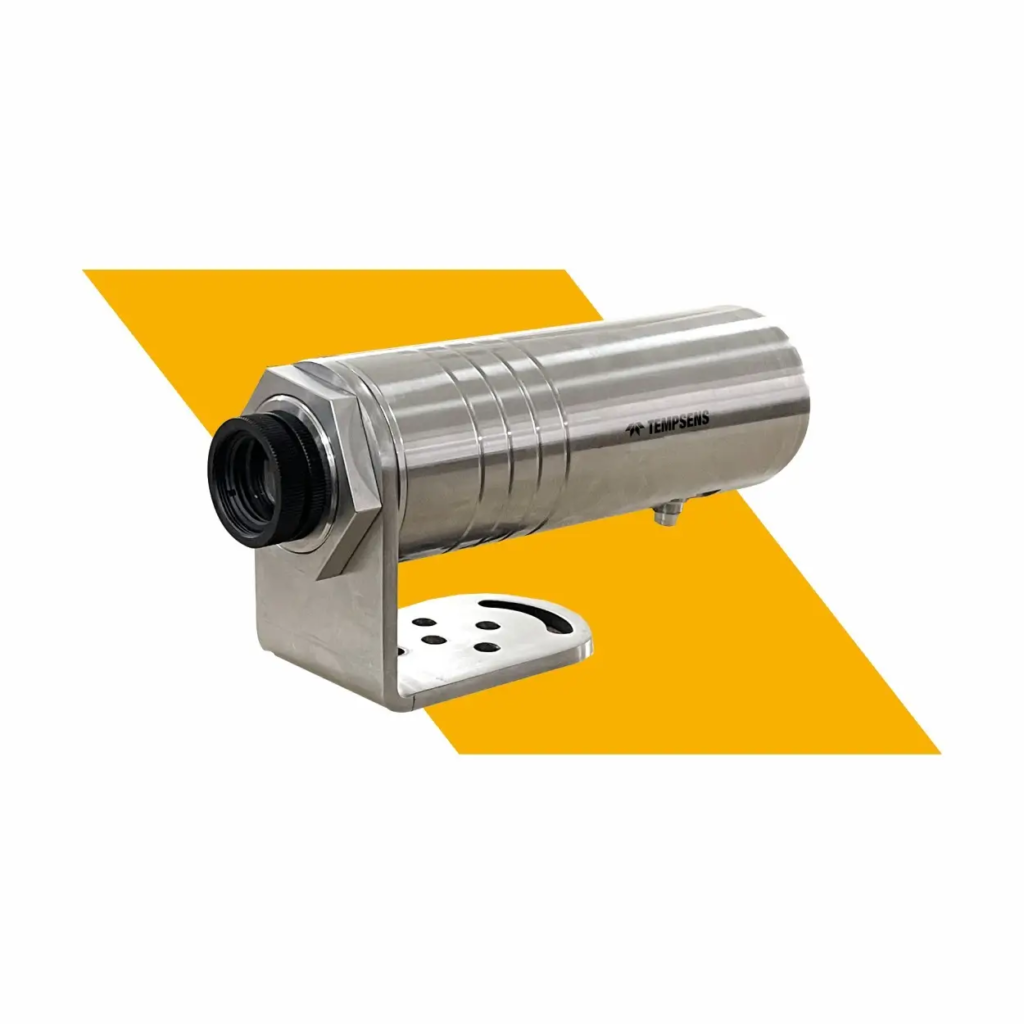
Heat treatment is one of those industrial processes where a few degrees can matter. Steel components, forgings, castings, billets, and other parts may need to reach a defined temperature and remain within a controlled range before cooling, quenching, tempering, or another thermal cycle.
The challenge is measuring that temperature reliably when the material is moving through a furnace, exposed to very high heat, or difficult to reach with a contact sensor. That’s where a temperature pyrometer becomes useful. It measures thermal radiation from the target surface without touching it.
For plant engineers, the question isn’t simply, “Which pyrometer has the highest temperature range?” The better question is, “Which pyrometer will give reliable readings on this particular material, at this particular distance, under these process conditions?”
That distinction can prevent costly measurement errors.
What is a Temperature Pyrometer?
A temperature pyrometer is a non-contact temperature measuring instrument that determines the temperature of an object by detecting the thermal radiation it emits. Unlike a thermocouple or RTD, it doesn’t need to physically contact the heated material.
Industrial pyrometers are commonly used when the target is too hot, moving, inaccessible, or likely to damage a contact sensor. They can be used for applications such as furnaces, forging, rolling, casting, heat treatment, glass processing, and metal production.
Infrared thermometers and radiation thermometers operate on the same basic principle of detecting thermal radiation, although industrial pyrometers can be designed for demanding continuous process measurements.
How is a Temperature Pyrometer Useful in Industrial Heat Treatment Measurement?
In high-heat processing, stopping a production line just to verify surface temperatures burns money through lost throughput and scrap rates. A pyrometer solves that headache by giving your team live temperature readings without touching the product or forcing line pauses.
It’s a game changer for plant output.
It supports continuous temperature monitoring
Having continuous temperature data changes how you run your thermal processing.
If your furnace drops temperature halfway through a cycle or cools down too fast, you end up with unpredictable hardness levels and costly scrap. Real-time monitoring catches thermal drift instantly so operators can tweak furnace settings on the fly instead of discovering defects during final quality checks.
A pyrometer can provide continuous readings that help operators identify whether the process is running within its defined temperature window.
It works with moving and inaccessible targets
Forging lines, rolling mills, conveyor-based heating systems, and furnace exits often involve moving material. A non-contact instrument can measure the surface without mechanical contact.
That’s a practical advantage when the target is moving at production speed.
It reduces contact-related measurement problems
Contact sensors can experience mechanical wear, contamination, response delays, or damage when exposed to harsh process conditions. A non-contact instrument avoids direct contact with the hot material.
That doesn’t mean a pyrometer is maintenance-free. Its optical path, lens, alignment, and calibration still need attention.
Cold spots and hidden hot zones kill product consistency fast.
Say your furnace setpoints look fine on paper, but one zone is running 15° hotter because a heating element is starting to go or an airflow baffle shifted out of alignment. If you aren’t checking actual surface temps at key points along the run, you won’t catch that imbalance until bad parts hit the lab for destructive testing.
Pyrometers spot those hidden temperature swings before they wreck a full shift of production.
An operator can aim the sensor at different target areas along the line to flag drift immediately. That lets your team adjust burner output or belt speed before whole batches get scrapped for inconsistent hardness or finish issues. It keeps your yields steady without adding manual check steps.
Emissivity must be treated seriously
A technically accurate pyrometer can still produce a misleading reading if its emissivity setting doesn’t match the target.
For example, a clean oxidised steel surface and a shiny metallic surface won’t necessarily behave the same way from the pyrometer’s perspective. Process engineers should therefore consider the material condition, surface finish, oxidation, viewing angle, and surroundings when setting up the measurement.
Tips to Select the Best Industrial Temperature Pyrometer
The best industrial temperature pyrometer is the one that matches the measurement conditions, not necessarily the one with the longest specification sheet.
1. Define the actual temperature range
Start with the lowest and highest temperature that must be measured. Don’t select an instrument only because its maximum range is higher than the process temperature.
For instance, if the process normally operates between 700°C and 1,000°C, the pyrometer should provide suitable accuracy and resolution across that working range.
2. Check emissivity requirements
You can’t just slap a basic single-color sensor on a line and expect clean data if surface conditions keep shifting.
Take a close look at your material type, surface finish, and oxidation levels before choosing hardware. Raw metal changes color and reflective properties as it heats up, which throws off single-channel readings and ruins your data accuracy. If your parts oxidize mid-process, switch to a two-color ratio pyrometer. It measures two wavelengths at once, so changes in scale, dust, or shifting emissivity won’t corrupt your temperature readings or cause false alarms on the floor.
3. Match the target size and distance
Your target needs to completely fill the optical field of view, or your numbers are junk.
If your sensor is mounted too far back from a small part, it’s going to average the temperature of the background furnace wall with the actual component. That gives your operators totally fake readings, leading to bad adjustments and thrown-out batches.
- Always verify the distance-to-spot ratio before mounting hardware on the line.
- Double-check that sight paths stay clear of heavy smoke, steam, or optical blockage.
Getting optics right up front saves hours of recalibration downtime later.
4. Consider response time
Fast-moving material requires a pyrometer with a suitable response time. A slow instrument can miss short temperature changes as the component passes the measurement point.
5. Evaluate the installation environment
Dust, smoke, steam, furnace windows, ambient temperature, vibration, and electromagnetic interference can affect practical performance. Fiber-optic configurations can be useful where the electronic or optical head needs to be positioned away from a high-temperature area.
6. Don’t overlook calibration
Calibration should be part of the selection process. For critical heat treatment applications, regular calibration can also help identify measurement drift before it affects product quality or process control.
Final Words
Picking the right pyrometer means looking at what your plant deals with daily. You need to account for temp ranges, part shapes, surface shine, viewing distances, reaction times, and harsh shop-floor conditions long before signing off on a purchase order. Skimping on that prep work usually leads to bad readings, constant recalibration, and scrapped batches.
Tempsens brings decades of hands-on experience in thermal engineering to help you avoid those exact headaches. They build single-color and ratio pyrometers that handle nasty industrial environments, along with fiber-optic setups for when the sensor head has to sit right in the hot zone. They help you get reliable data on the first pass so your line keeps moving without costly surprises. Tempsens also provides temperature calibration capabilities, including non-contact pyrometer calibration.
