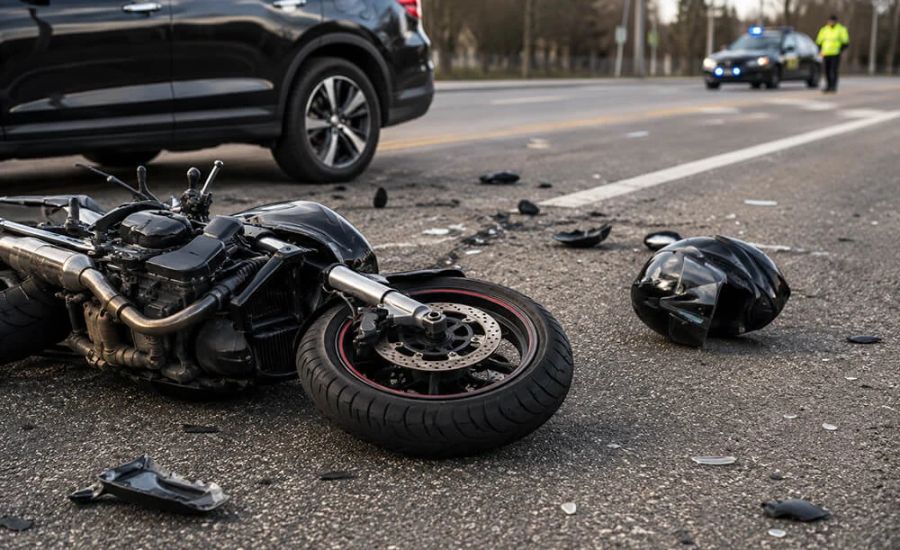
According to the National Highway Traffic Safety Administration (NHTSA), 6,335 motorcyclists were killed in traffic crashes in 2023, and an estimated 82,564 were injured. In its May 2025 safety announcement, NHTSA reported that the motorcyclist fatality rate per 100 million vehicle miles traveled was nearly 28 times that of passenger car occupants.
Victims of motorcycle accidents face several setbacks. They may suffer serious injuries, pay expensive medical bills, lose potential income, and face long-term rehabilitation costs.
But there is possible compensation for these injured motorcyclists in the US. The amount depends on injury severity, available insurance coverage, evidence of fault, and the long-term impact on the victim’s life. Understanding these factors can help injured riders determine their options for pursuing a claim.
Let’s take a closer look at how a motorcycle claim is determined and what damages injured riders may be able to recover.
The Injury Sets the Damages, and the Policy Sets the Payment
Each claim is against money that had been bought prior to the crash. People do not get paid based on what a jury believes is fair. They are paid based on a policy number that was selected by the one who hit them.
The floor in California was changed at the beginning of the previous year. The state Department of Insurance set the floor at $30,000 for each bodily injury or death, $60,000 for an accident, and $15,000 for property damages, from the previous values of $15,000, $30,000, and $5,000, with the new rates coming into effect as policies are renewed in 2025.
The doubling of a floor rate that hadn’t moved in decades is quite a difference but still a small sum compared to a motorcyclist’s injury. Even the break of the femur and four days in a trauma ward are enough to clear $30,000 out of the way.
Practitioners taking these files usually see the whole spread of collision work. In Connecticut, a Middletown motorcycle accident lawyer handles personal injury cases to secure the most favorable outcomes possible. With the help of the legal professionals, victims can focus on their healing.
The Claim Is a Documentation Exercise Before It Is an Argument
Adjusters decide on paper. What a rider can show about treatment, time away from work and the condition of the bike is what the file holds, and the file is what an adjuster prices.
Filing a claim for motorcycle accidents generally consists of getting proper treatment, filing the claim right away, taking pictures and keeping witness statements, tracking down costs incurred and losses suffered, and conducting yourself properly when dealing with insurance companies.
By doing all of these things, an injured biker can ensure that valuable evidence is not compromised.
The Other Driver’s Policy Is Frequently Not The One That Pays
Riders must have coverage for cases where the other driver fails to carry adequate insurance. The state Insurance Department sets the minimum liability limit as $25,000 per person for bodily injury liability and $25,000 for property damage liability, or $50,000 for a single limit, along with uninsured or underinsured motorist coverage with limits of $25,000 per person or $50,000 per accident.
California treats the same coverage as a choice. The consumer guide published by that state’s insurance regulator says a company has to offer it, and a driver who turns it down signs a waiver. A California motorcyclist’s protection against an underinsured driver may depend on whether they accepted or rejected that insurance coverage years before the accident.
That difference decides real cases. When a driver carrying the state floor puts a rider in a trauma center, the rest of the number has to come from the rider’s own policy or from nowhere at all.
Fault Comes Off The Top of Whatever Is Left
Two states with similar coverage can still produce different checks, because a percentage gets subtracted before anybody signs one.
Connecticut fixes that line by statute. Injured individuals can receive compensation if they are less responsible for the accident. The compensation is reduced based on their share of fault. For example, someone who is 20% responsible may receive 80% of their total damages.
Not greater than is the phrase doing the work. A rider found exactly half at fault still recovers half.
California draws no line at all. The Supreme Court of the State replaced the old rule in Li v. Yellow Cab Co., holding that an injured person’s own negligence does not bar recovery and that damages shrink in proportion to the negligence attributable to that person. A rider found eighty percent responsible in California still recovers twenty percent.
Motorcycle files attract fault arguments the way almost nothing else does. Speed, lane position, conspicuity, and gear all get argued over, and every point assigned to the rider comes straight out of the recovery.
The injury sets what the damages could be. The coverage sets how much of that the claim can actually reach. The fault split then takes its share of the remainder. Riders learn the first number in a hospital and the other two months later, usually from somebody explaining why the figure on the check does not resemble the figure on the bills.
