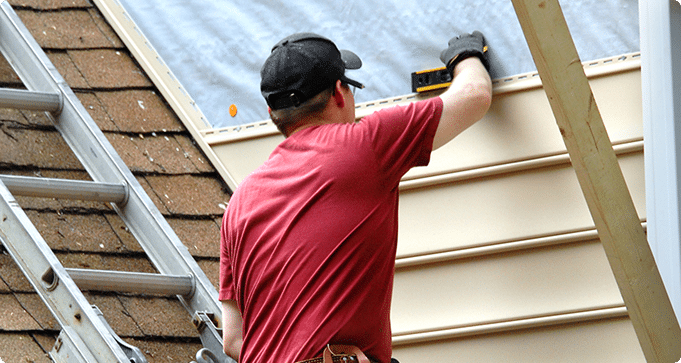
Siding is one of those construction types of work that is expensive enough to matter to you, revealing enough to prove the poor work of others for years to come, and complex enough that most homeowners have no idea what to look for in terms of acceptable work until water appears somewhere it shouldn’t. And typically the weakness of a poor installer is not reflected in the bid documents. Rather, it manifests itself in the details of the flashing, the spacing of fasteners, and whether or not the installer even understood the concept of a drainage plane behind a panelized siding product.
What to Check, How to Read the Contractor’s Proposal and Where is the Real Risk with Siding Work?
Verify licensing, insurance, and manufacturer standing separately
The above named credentials are frequently referred to collectively, but each is intended to protect against a different kind of failure. So verify each individually.
Licensing, This verifies that the contractor is operating legally within your state or municipality. Most states also maintain a record of past complaints filed against licensed contractors as well as any bond requirements. Liability insurance, This protects your property if the contractor damages it in some way. Workers’ compensation, This protects you if a worker is injured on your property. Note that the absence of this type of coverage is typically an unknown risk to homeowners.
Ask for the certificate, not the number
Verify that the contractor can provide a Certificate of Insurance issued by the carrier to verify the policy is current. Verify the policy limits are adequate to cover the damage in the event of a contractor’s error, and verify the limits are greater than the replacement cost of your house.
Manufacturer certification, Check that the siding you’re being quoted has a recognized certification program for installers (e.g. Hardie’s installer training program for fiber cement siding). These programs often have extended labor warranties that the manufacturer will honor, and it is worth checking how your installer measures up in these programs.
Read reviews for failure patterns, not sentiment
While average star ratings give some insight into reviews for a contractor after a certain volume of work, the real value comes from negative reviews and how the company responds to them.
- Scheduling complaints that cluster in a single season usually indicate capacity strain, not incompetence.
- Repeated mentions of change orders appearing mid-project point to deliberately thin initial bids.
- Any review describing water intrusion, buckling, or fastener failure within two years deserves a direct question in the interview.
- Silence from the company on every negative review suggests there is no process for handling callbacks.
Look at work that has aged
When looking at photographs of completed work, look at how the work looked the day the crew left your property. Look at the corners, the work around windows and doors, and where the siding meets the trim at walls, dormers and porches. Look for signs of movement and for signs of moisture. These are the first signs of problems with a siding installation. Do they indicate that the installer attempted to allow for the expansion and contraction of the siding?
Separate the material warranty from the workmanship warranty
Usually, material warranties don’t cover installation problems, so you need to know which document will cover which kinds of problems with your home.
| Coverage type | Typical duration | What it actually covers | Common exclusion |
| Manufacturer material | 25 years to limited lifetime | Product defects, fade limits on some lines | Improper installation, prorated after year 10 |
| Contractor workmanship | 1 to 10 years | Installation errors, flashing, fastening | Storm damage, settlement, prior substrate rot |
| Manufacturer extended labor | 5 to 25 years | Labor to correct covered defects | Requires certified installer and registration |
Confirm who registers the warranty
Most extended warranties require registration by a fixed date. List this as a requirement in the contract and ask for confirmation that it has been done. Get a copy of the confirmation.
Read the estimate line by line
A qualified bid will describe a scope of work in detail. A low bid typically describes only a price to complete a job. The key differences when shopping for a contractor to complete your siding are usually described but not necessarily included in the proposals of most qualified installers.
- Removal and disposal of existing siding, including who handles unexpected substrate repair and at what unit rate.
- The water resistive barrier being installed, named by product, along with the flashing method at windows, doors, and penetrations.
- Fastener type and length, which determines whether the installation meets the manufacturer’s wind rating.
- Trim, soffit, and fascia scope, frequently excluded and then added later as a change order.
- Payment schedule tied to milestones rather than dates.
Weigh experience against the specific assembly
The number of years of experience with vinyl does not translate to experience with rainscreen siding and old homes with no sheathing. Ask the installer for the number of jobs that his crew has completed with the same exact material and type of siding on similar walls. Ask for the name of the person who will be on site every day. If you are gathering bids in Northern Virginia, it is worth asking established siding contractors in Alexandria VA to walk you through comparable projects on houses built in the same era as yours.
Look for a company that has a regular, core crew of installers rather than a company that continuously sends different people to different jobs. (Ideally the person who sold you the siding would be on site as well.) Companies that continuously send out different installers cannot possibly guarantee to implement the installation standards you will have discussed, and it will become extremely difficult to enforce your workmanship warranty after the point that the installing person leaves their job.
