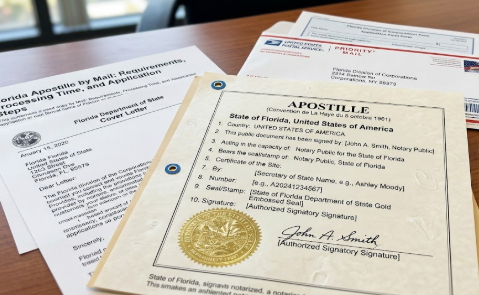
Florida Apostille by Mail: Requirements, Processing Time, and Application Steps
When a Florida document has to be recognized abroad, a plain copy will not satisfy a foreign authority. An apostille supplies the missing confirmation, and for many residents, the simplest way to obtain one is by mail. This article covers who can use the mail option, what to prepare, how to submit, how long it takes, and the mistakes that send documents back.
Can You Request an Apostille in Florida by Mail?
The Florida Department of State does accept mailed requests through the Division of Corporations’ Apostille Section in Tallahassee, the only office in the state authorized to issue apostilles. Every mailed request reaches the same place, wherever you live. Two questions decide whether mail is the right choice for you: who qualifies to use it, and when it makes more sense than going in person.
Who Can Apply by Mail?
Anyone with an eligible Florida document can apply by mail, individual or business, with no need to appear in person. Residents rely on it because there is no local counterpart: whether you are arranging an apostille in Jacksonville or an apostille in Miami, the request still travels to Tallahassee.
When to Choose Mail Submission
Mail suits requests that are not urgent. Walk-in service exists in Tallahassee for faster turnaround, but for someone handling an apostille in Orlando or an apostille in Tampa, the drive often outweighs the time saved.
What Documents Do You Need Before Mailing Your Request?
The state authenticates original certified copies and properly notarized originals. Photocopies and faxes are rejected, so the version you send matters as much as the request.
Certified vs. Notarized Documents
The two accepted categories work differently:
- Certified copies. Vital records and court documents must be original certified copies from the proper Florida official, carrying the original signature and seal.
- Notarized documents. Affidavits, powers of attorney, and similar papers must be signed before a Florida notary, with a complete notarial statement, signature, stamp, and seal.
The notarial wording must be in English, even when the document itself is not.
Forms, Fees, and Return Shipping
Every mailed package needs four things together:
- The completed Apostille and Notarial Certificate Request Form.
- The original certified or notarized document.
- Payment of $10 per document ($20 for documents certified by a Florida Clerk of the Court), by check or money order payable to the Florida Department of State.
- A self-addressed stamped envelope or pre-paid air bill, naming you as both sender and recipient.
The state accepts no cash or credit cards, and checks must be drawn on a U.S. bank.
How to Mail a Florida Apostille Request Step by Step
Once the pieces are ready, the submission itself is straightforward, and it comes down to three steps. Working through them in order is what matters, since a step taken out of sequence or skipped is the usual reason a request comes back.
1. Prepare Your Application Package
Name the destination country on the form, since the state issues an apostille for Hague Convention countries and a certificate of authentication for others. Assemble the form, document, payment, and return envelope together a Florida apostille request missing any of these is returned unprocessed.
2. Send Your Documents
Mail the package to the Division of Corporations, Apostille Section, 2415 N. Monroe Street, Suite 810, Tallahassee, FL 32303. Use adequate postage; postage-due envelopes are held before delivery.
3. Track Your Apostille Request
Use a trackable return envelope or air bill so you can monitor the return trip. The office processes requests in the order received.
How Long Does It Take to Receive a Florida Apostille by Mail?
Plan for several weeks. Mail is the slowest of the available routes, and the figure the state publishes covers only the time your request spends inside the office. Two things shape the total: the standard processing window the state works to, and the circumstances that can stretch it beyond that.
Standard Processing Times
The Department of State reports roughly 25 to 35 business days from the day it receives your package. Transit both ways adds more, so a realistic total is about six to nine weeks.
Factors That May Delay Processing
Several things extend that window:
- A document version the state cannot accept.
- Incorrect or missing payment.
- Seasonal volume, holidays, or staffing levels.
No expedited mail option exists. When speed matters, the Tallahassee walk-in service or a professional submission is faster.
Common Mistakes That Delay Florida Apostille Requests
Most returned requests fail on avoidable details rather than the document’s merits, and each one restarts the weeks-long clock. The three below are the ones most worth checking before the package goes out.
Sending the Wrong Document Version
Photocopies, uncertified printouts, and documents notarized outside Florida are all rejected. Confirm you are sending an original certified copy or a correctly notarized Florida original.
Missing Payment or Required Information
An incorrect amount, an out-of-country check, or an incomplete form stops the process. The Hague apostille in Florida is issued only when the form names the destination country and the payment matches the fee.
Incorrect Mailing Instructions
The return envelope must show your name as both sender and recipient. Omitting it, or leaving off return postage, can send your document back untracked or hold it entirely.
When Professional Apostille Services Are Worth Using
Professional help earns its place when accuracy or speed is critical. A service reviews the document before it reaches the apostille office in Tallahassee, catching wording or certification problems that would cause a rejection. Providers also route documents to the correct authority, arrange certified translations, and can submit in person to beat the standard mail window often justifying the cost on a deadline-bound filing
