
It’s not just a matter of sending a CAD file to a machine shop to make a digital component into a real metal part. The choice of materials, method of manufacture, tolerances, surface finish, and quantity of products all play a part in the finished product. The properties of zinc – strength, machinability, corrosion resistance, and finish quality – make it an appealing choice for many engineered parts. The streamlined digital workflow enables you to go from CAD upload to design review to CNC machining to finishing to inspection to delivery without all the production delays.
- Start With a CAD File Built for CNC Production
The journey towards machining starts with a detailed 3D CAD model, which specifies the desired geometry of the zinc component. Manufacturing information can be gained from STEP, STP, IGES, and other common formats.
But it isn’t enough to upload a file. Manufacturing review will evaluate wall thickness, internal features, hole size, radius, tolerance, and other geometric characteristics that impact CNC accessibility.
The less uncertain the situation is prior to machining, the better a model will be prepared. It also serves to identify characteristics that can call for unique tooling, extra setups, or other approaches to machining.
- Move From Digital Geometry to Manufacturability Analysis
Once the CAD Model is received, the next step is Design for Manufacturability (DFM) analysis. This process links the designer’s desires with the capabilities of CNC equipment.
The review can reveal unnecessarily tight tolerances, surfaces that are hard to reach, thin sections, deep cavities, and other features that can make the machining more difficult. Based on this, engineers can then make recommendations for practical changes, while maintaining the basic function of the component.
This is particularly critical if zinc components have complex shapes. CNC milling offers superb dimensional control; however, features need to be accessible to cutting tools.
- Select the Zinc Alloy Around the Part’s Function
Zinc is not one material specification. There are various zinc alloys available that offer various combinations of strength, hardness, ductility, dimensional behavior, and machinability.
Zamak 3 is a popular material due to its good balance of properties, including strength, hardness, and ductility. When mechanical requirements are higher, Zamak 5 offers greater strength and hardness. ZA-8 offers another option where greater strength and hardness are important.
Instead of being chosen for convenience of machining, the alloy used should be selected because of the operating environment, mechanical requirements, dimensional requirements, and type of finish desired for the component.
- Use Zinc CNC Machining Services for Controlled Part Production
Today, a modern zinc CNC machining services can take your approved design geometry and transform it into prototypes, replacement parts, functional assemblies, and production parts, all with a certain level of dimensional control. CNC milling centers can accurately remove material step by step to replicate complex shapes repeatedly based on the programmed tool path.
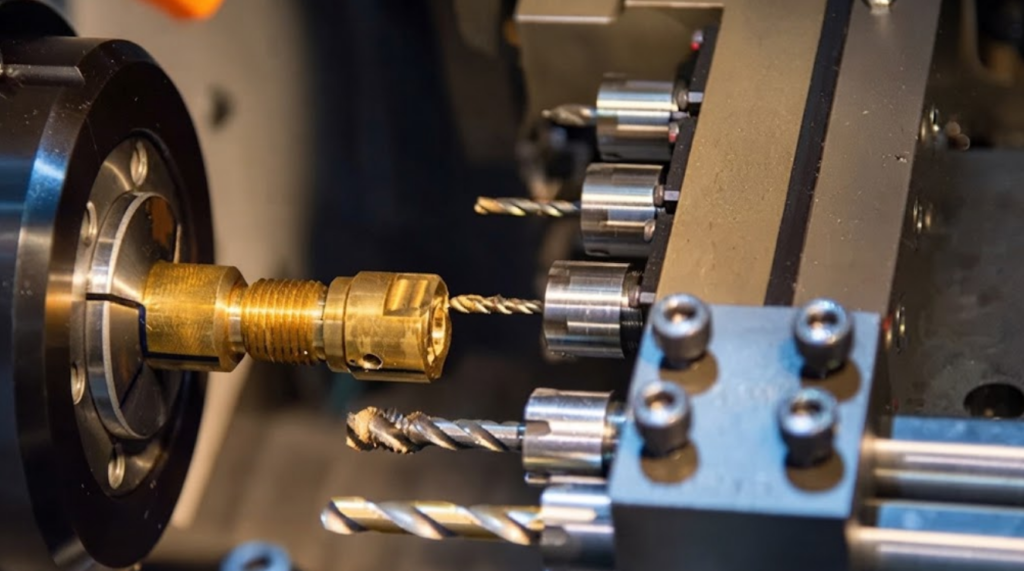
Many conventional parts can be processed on three-axis machines, and five-axis equipment allows access to angled and complex surfaces. Flexibility is good for parts like gears, fittings, valve bodies, couplings, housings, brackets, and decorative parts.
Tolerances can be held close for demanding designs, where the component and machining process can support these tolerances. Actual achievable tolerance is dependent on geometry, alloy, feature size, machine capability, tooling, and inspection requirements.
- Control the Manufacturing Workflow From Prototype to Volume
The zinc CNC machining process can assist various production phases and does not have to be forced into the same manufacturing model. One prototype can be employed to test dimensions, assembly relationships, or functional characteristics prior to mass production.
Then, low-volume manufacturing can help fill the gap between prototype validation and larger production volumes. CNC machining can deliver repeatable batches of established designs, with the same basic geometry and material specification.
A structured workflow typically follows these stages:
CAD Upload & Engineering Review
Material, quantity, tolerance, and finishing requirements are uploaded in the digital model. Manufacturing considerations are identified, and the design is assessed by engineers.
Quotation and DFM
The supplier assesses the difficulty of machining, material usage, tooling, finishing, and quantity of production before giving pricing and lead time.
CNC Manufacturing
After the order is confirmed, the approved program guides the machining operation. If the part must be accessed from several directions, multiple setups or machining axes can be used.
Inspection and Delivery
Finished parts are checked against the specified requirements prior to packaging and shipping. Standard production routes can be used for simple eligible components and provide a lead time as short as three days.
- Choose Finishing According to Performance Requirements
While the machining process may establish the main shape, finishing may also affect how the component looks, behaves on the surface, and how it withstands environmental exposure. Zinc parts can be treated in a variety of ways for various uses.
Electroplating can be used to coat the surface with metal and enhance aesthetics or corrosion resistance. Electroless nickel plating can be used to obtain a harder, more wear-resistant surface. Chromate conversion coatings can enhance corrosion protection without increasing the thickness of the coating to a great extent.
Powder coating is another type of durable surface treatment, especially when color and other surface protection is important. This depends on the dimensional tolerances, operating conditions, required appearance, and the condition of the substrate.
- Match Zinc Machining With Real-World Applications
The attractive physical properties, low friction, corrosion resistance, and finishing possibilities of zinc render it a material that is useful for a wide variety of components. It can be applied to mechanical products, automobiles, electronics, industry, medical, and decoration.
Some of the more common examples are automotive handles, gearbox parts, valve bodies and stems, hydraulic parts, connector housings, shielding cases, locks, brackets, medical equipment housings, fittings, and decorative parts.
The material is especially useful where a component has to be both more durable and dimensionally stable than many plastics can be made to be, but also requires relatively easy machining and attractive finishing options.
- Complete the Journey With an Integrated Manufacturing Partner
When engineering review, machining, finishing, inspection, and logistics are a coordinated process, the CAD-to-part process becomes more efficient. But instead of seeing each stage as a standalone task, an integrated manufacturing service can be used to link digital design information directly to the production planning.
3ERP is a CNC machine shop that is integrated with other rapid manufacturing capabilities and is ISO 9001:2015 certified. It has CNC facilities for zinc parts for prototypes and production, with equipment and engineering resources being capable of handling simple and complex geometry.
Conclusion
When a zinc part’s CAD file arrives at a CNC machine, it’s not a finished part. The choices that are made between digital design and delivery are critical to successful production. The choice of material, DFM analysis, machining strategy, tolerances, finishing, inspection, and production volume all play a role.
A structured zinc CNC workflow provides practical guidance for manufacturers, from CAD upload to physical components, and ensures control over quality and specifications. With the right zinc alloys, powerful CNC machines, and rigorous engineering processes, intricate digital designs can be transformed into accurate parts that are then prepared for assembly, testing, or production.
Bless Insight is dedicated to exploring the lives, journeys, and achievements of influential people, offering readers inspiration and valuable life lessons.
