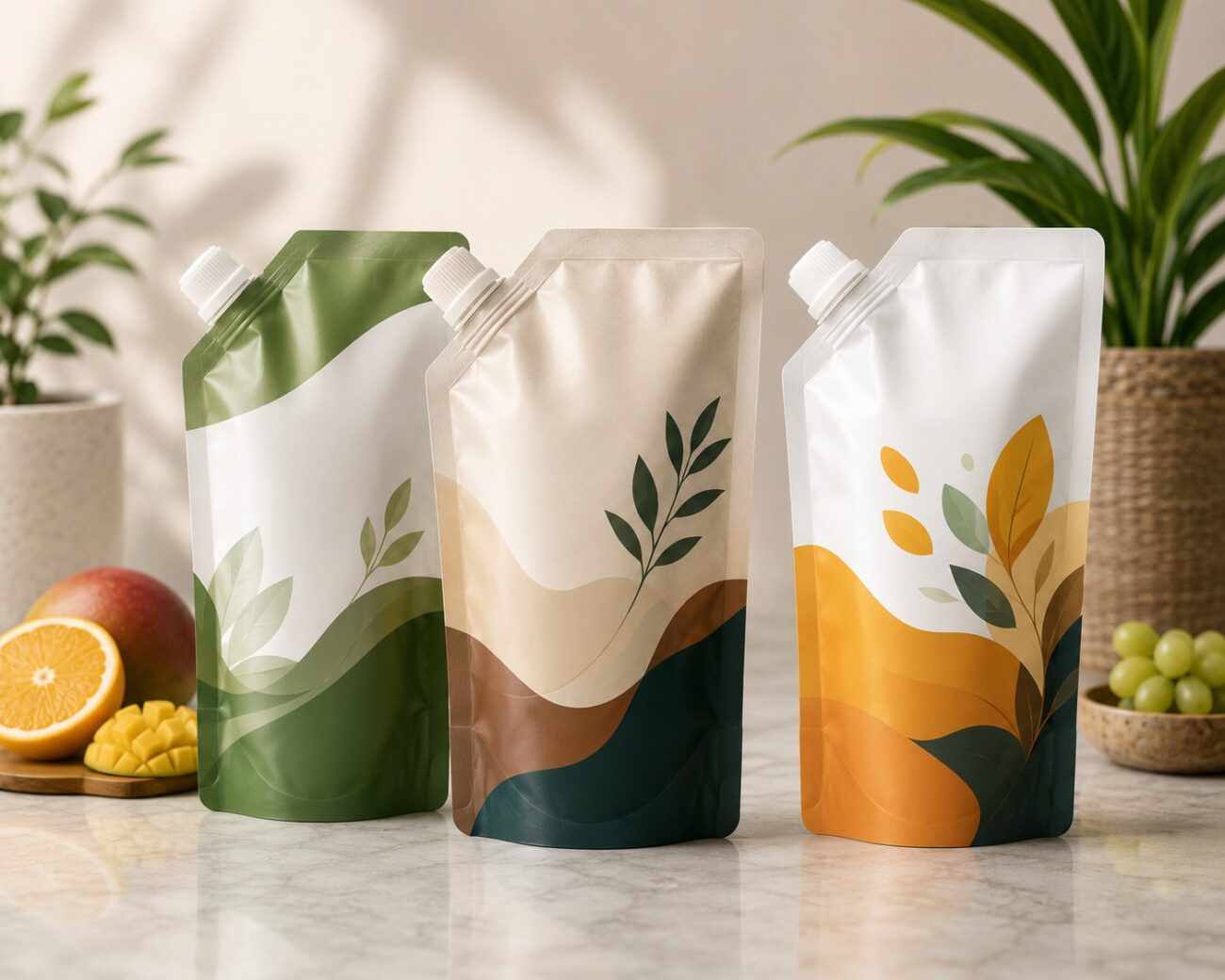
The decisions of packaging are hardly given the attention they should receive until something goes wrong. A seal breaks during transit, a pouch will not stand up on the shelf or a spout will spill before a product ever gets into the hands of a customer. Spout pouches are one of the newest types of packaging used to package liquid and semi-liquid products such as sauces, drinks, liquid supplements, and personal care products. Since they address a problem that bottles and jars cannot: they pour smoothly, reseal and stand upright without the additional weight and risk of breakage of glass or hard plastic.
Not all spout pours are constructed in the same manner and making a wrong choice of specifications can nullify all the advantages that the format is expected to provide. This is a guide through the practical considerations that ought to influence a custom spout pouch decision that begins with the product itself rather than the artwork.
Know Your Product Before You Touch the Artwork
One is tempted to start with colors, logos and layout but packaging decisions must first be made regarding the physical qualities of the product. The questions that are important than design at this point are:
- Viscosity: thin fluids such as juices and electrolyte drinks, require a different spout size and flow rate compared to thick sauces or lotions.
- Weight: fill volumes that are heavier require thicker film and stronger seals to prevent stress at the seams.
- Moisture and fill level: the base gusset must support the pouch in an upright position at whatever level of fill the product can be sold at not only when it is full.
- Oxygen sensitivity: sauces, beverages and liquid supplements normally require oxygen barriers to maintain freshness and taste.
- Light sensitivity: there are liquid formulas that degrade under UV or visible light which determines the type of clear, matte or metallic film to use.
By ensuring that these details are correct before handling the artwork, expenses associated with redesigning the artwork are avoided.
Match the Material Structure to the Product
After knowing the needs of the product, the next decision will be on the choice of materials. This step is even more important to liquid-filled pouches than to dry products because moisture and oxygen attack a wet product more quickly.
This is where mylar packaging bags come into the picture. Metallized or foil layers provide good protection against light, oxygen and water which all destroy flavor, strength and freshness with time. The barrier is capable of giving the sauces, drinks and liquid supplements a shelf life of weeks or months longer than thinner films.
The thickness of the film must also correspond to the distance that the product is going to travel. A cross-country pouch must be constructed stronger than one going to a shop a few miles down the road. That is why it is better to indicate thickness by the distance of shipping instead of using the heaviest variants of the package by default.
Design for How the Pouch Will Sit on the Shelf
What may have been a terrific pouch when empty, will act in a quite different way when filled and put on a shelf. It depends on a few structural specifics on how it performs in a retail environment:
- Base gusset: made to hold the pouch erect even at a partial level of fill because weight of liquid will change as it is used.
- Stability: the pouch should not tip, lean or fall over when stacked with other products.
- Footprint: a smaller base means that more units can be packed in a shelf row that retailers are aware of.
- Visibility: the front panel must provide a flat and uninterrupted space to brand and label information needed.
Such information is simple to ignore during the initial design phases but is apparent the second a pouch is filled alongside the competition.
Pick the Right Spout and Cap for the Job
The actual spout is a small shaped fitment that is welded onto the top of the pouch or the corner but it does most of the work. Its what causes the product to flow in a regulated flow rather than spill and what makes it fresh after resealing. It is influenced by a handful of decisions that determine its performance:
- Spout size: thin liquids can be spouted with a thinner spout whereas thicker sauces or lotions require a larger spouting.
- Spout location: top-center, top-corner or side location influences the natural ability of the pouch to pour when tilted.
- Type of cap: flip-top caps are more convenient to use with one hand, screw caps are better resealed and tamper-evident seals are important in CBD and with personal care and supplement products where compliance is a consideration.
One of the most frequent causes of returns is putting the spout in the wrong place as it is the size of the spout or the seam that is poorly welded that is likely to cause the leakage.
Plan for Shipping and Handling Not Just the Shelf
A good shelf package may fail in a shipping box. Stacking of distribution conditions, variations in temperature, and transit, storage time. Any stress on seals and material and liquid contents introduces additional mass and motion which dry products do not need to consider. Goods that are shipped in bulk or over long distances usually require heavier film, heavier seals and more ample gusseting than goods sold locally or retrieved at the store. This is a step that is mostly ignored and appears later in the form of returns, spoilage or complaints which are not related to the formula of the product.
Test a Small Batch Before You Commit to a Large Run
Another very frequent and costly error that brands commit is not testing, but going to a full production order. A small test batch with filling, sealing and spout-rate testing and even a simple shipping test that shows issues before they are expensive to repair. A leak, a bad weld or a spout which is improperly sized to take a certain product in its viscosity is much easier to fix on a sample of several hundred than on an order of tens of thousands.
Vet the Manufacturer as Carefully as the Pouch Itself
The manufacturer behind the pouch can matter just as much as the specifications chosen. A well-designed pouch can still create problems if the manufacturer doesn’t have the right equipment, material expertise or quality-control process in place.
When evaluating a manufacturer for printed spout pouches, it’s worth looking at their material and film expertise, printing consistency, seal and spout-weld quality, ability to customize spout size and position, sampling process before bulk production and their overall production capacity and consistency across larger orders. A manufacturer that manages material selection, printing, sealing and spout welding under one process tends to make it easier to maintain consistency from the first sample through a full production run.
Packaging Suppliers Brands Compare for Spout Pouches
Brands often compare several suppliers before choosing a spout pouch manufacturer, considering materials, printing, sealing, customization, order requirements, turnaround and whether other packaging formats are available.
Kwick Packaging
Brands comparing suppliers such as Packlane, Vivipins and BOWE Pack can also source spout pouches and other packaging solutions from Kwick Packaging. The following two customer reviews offer insight into the experience from a customer’s perspective:
“Great pricing, quick work and the bags we received were quality. The design team on the free design with your order isn’t very great and there are language barriers. However for the price and speed this company is solid. I’d suggest using your own design for the quickest, best results. We used a design that was created for a diff product and the team was able to rearrange it to our desire! Would use again.” Hank
“We had never been asked about getting empty mylar packets before, but after a quick look online I found Kwick Packaging. Their quote beat the other company I was looking at, and once we started working on it, Peter and Melvin were super helpful throughout the process and made sure I got exactly what I was looking for. The turnaround time wasn’t bad either!” FASTSIGNS
Reviews like these are a useful reality check and they highlight that pricing, turnaround and communication matter just as much as the technical specs on paper.
Packlane
Packlane focuses on custom packaging solutions including printed boxes and selected flexible formats, making it an option for brands comparing different packaging suppliers.
Vivipins
Vivipins primarily specializes in custom pins and promotional merchandise with packaging available as part of its broader product offering rather than a core focus.
BOWE Pack
BOWE Pack offers flexible packaging solutions for brands seeking standard and customized pouch formats with options that can support different product and packaging requirements.
Avoid These Common Mistakes
Most of the issues that the brands face regarding this format are as a result of a few recurrence mistakes:
- Skipping the test batch and going straight to bulk production.
- Choosing spout size based on looks alone without checking it against the product’s viscosity.
- Prioritizing design over seal and weld quality, resulting in a pouch that looks good but leaks.
- Ignoring shipping conditions, then discovering seal failures after products reach the warehouse.
- Underestimating the base gusset, leading to pouches that tip over once partially used.
- Not confirming minimum order quantities and lead times before committing to a manufacturer.
These errors can be prevented by a brief testing period and a straightforward discussion with the manufacturer beforehand.
Conclusion
Selection of the spout pouch is all about finding the right balance between four factors: product protection, practical performance on the shelf and shipping, presentation that helps the brand and a manufacturing partner that can be counted on to provide the same results each new order. The correct first viscosity, material and spout choice ensures that the design and manufacturing discussions that follow are much easier.
