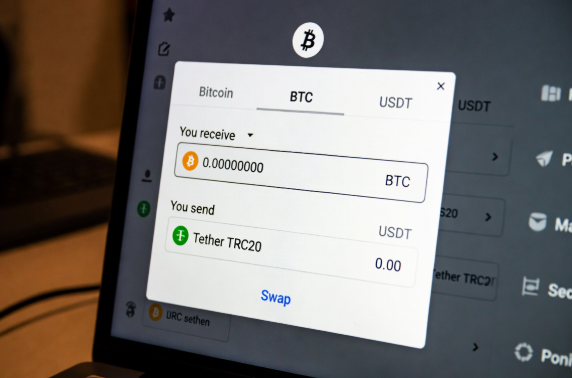
There’s an interesting pattern in the cryptocurrency market: not every exchange transaction is driven by a desire to acquire a new asset. In many cases, users exchange cryptocurrency for more practical purposes: preserving the value of their funds, preparing for future transactions, or reducing the impact of market fluctuations. This is why the Bitcoin to Tether TRC20 exchange remains one of the most popular among digital asset owners. Bitcoin (BTC) is considered the leading indicator of the cryptocurrency market. When its price rises or falls, it impacts virtually the entire industry. However, BTC’s high popularity is accompanied by significant volatility. The asset’s price can fluctuate significantly even within a single day. For some market participants, such fluctuations present opportunities, while for others, they create additional risks.
In such situations, many users exchange BTC for USDT. The Tether stablecoin allows capital to be preserved within the cryptocurrency infrastructure without leaving the market entirely. The TRC20 format, which operates on the Tron network and has long been the standard for fast transfers between wallets, platforms, and services, is particularly popular.
Why Bitcoin Owners Are Switching to USDT
Sometimes, exchanging Bitcoin for the stablecoin Tether USDT on the TRC-20 network is perceived as a move away from cryptocurrency investments, but in practice, this is absolutely not the case. In most cases, it’s a temporary change in the asset structure. When a user converts Bitcoin to a stablecoin, they remain within the cryptocurrency ecosystem. Funds can still be quickly used to purchase other assets, transfer them to various platforms, or participate in investment strategies. The difference is that the value of Tether (USDT) is pegged to the US dollar and doesn’t experience the same sharp fluctuations as Bitcoin.
The most common reasons for exchanging BTC for Tether are:
- to lock in asset prices after a market rally;
- to prepare for the purchase of other cryptocurrencies;
- to temporarily reduce investment risks;
- to preserve capital within the digital environment;
- to wait for more favorable market conditions;
- to increase flexibility in fund management;
- to facilitate further payments in the cryptocurrency space.
Essentially, USDT is becoming a kind of intermediate stop between various stages of working with digital assets.
Why TRC20 has become one of the most popular USDT formats
Today, Tether exists on several blockchain networks, but the TRC20 version has become particularly widespread among cryptocurrency users. This is due to the specific features of the Tron network, which is focused on fast transaction processing and active use in everyday transactions. In fact, TRC20 has become one of the main transport mechanisms in the cryptocurrency market. Huge volumes of funds pass through it daily, moving between exchanges, exchange services, investment platforms, and private wallets.
The popularity of this standard is due to several factors:
- high transfer processing speed;
- convenience for international payments;
- widespread adoption of the Tron network;
- support by numerous services;
- active use in cryptocurrency trading;
- accessibility to users worldwide;
- developed service infrastructure.
Thanks to these features, TRC20 has become one of the most popular options for storing and transferring digital assets.
When BTC to USDT exchange becomes part of a strategy
Interestingly, many experienced market participants view converting Bitcoin to Tether TRC20 (USDT) not as a standalone transaction, but as an element of capital management. In the cryptocurrency space, it’s not just the ability to purchase assets that’s important, but also the ability to promptly adjust portfolio structure. For example, during periods of high uncertainty, some investors prefer to transfer funds to stablecoins. This allows them to quickly return to the market when new opportunities arise. As a result, the exchange serves a strategic rather than a technical function.
When choosing the right time and service, users typically consider:
- the current market situation;
- the intended use of the funds;
- exchange terms;
- transaction speed;
- ease of receiving USDT;
- the reliability of the chosen platform;
- the availability of the required exchange volume.
This approach helps use stablecoins as a fully-fledged digital asset management tool.
Why electronic exchangers are often chosen for exchanging BTC for USDT
Once the decision to convert has been made, it’s important for the user to complete the exchange quickly and without unnecessary steps. This is why electronic exchangers remain a popular tool for transactions between Bitcoin and Tether. Unlike services focused on active trading, exchange platforms allow you to focus solely on the conversion. Users don’t need to analyze exchange interfaces or perform additional tasks. The service’s main goal is to ensure a simple transfer from one asset to another.
The popularity of exchangers is explained by the following advantages:
- clear transaction procedures;
- quick order processing;
- convenience of working with popular cryptocurrencies;
- no need to use trading tools;
- quick receipt of USDT;
- convenient format for one-time and regular exchanges;
- time savings when converting assets.
For many users, this format is the most convenient way to transfer funds from Bitcoin to stablecoin.
