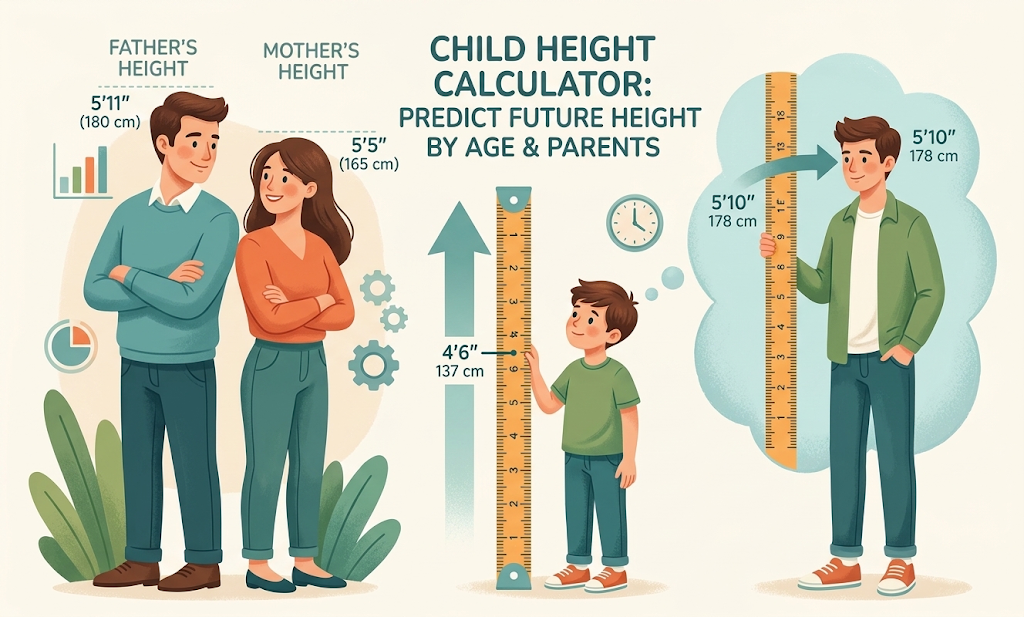
Parents are often curious about how tall their child may become as an adult. While no tool can predict a child’s final height with complete certainty, a Child Height Calculator can provide a useful estimate based on factors such as the child’s age, current height, sex, and the heights of both parents.
A child’s final adult height is influenced largely by genetics, but growth is more complex than simply averaging the mother’s and father’s height. Nutrition, hormones, overall health, puberty timing, sleep, and normal individual development can also affect how a child grows.
The Child Height Calculator on MacroAndMeals is designed to make this estimation process simple. Instead of calculating growth formulas manually, parents can enter the requested information and receive an approximate future height result.
This guide explains how child height prediction works, how parental height is used, what affects growth, how accurate predictions may be, and how to interpret the result responsibly.
What Is a Child Height Calculator?
A Child Height Calculator is an online tool that estimates how tall a child may become when fully grown.
Depending on the calculator, it may use information such as:
- Child’s current age
- Current height
- Sex
- Mother’s height
- Father’s height
- Current growth measurements
The calculator processes this information using a height-estimation method and provides a predicted adult height.
The result should not be viewed as a guaranteed final measurement. Instead, it provides an approximate idea of a child’s potential adult height based on available information.
For example, if both parents are relatively tall, their child may also have a greater genetic potential for above-average height. However, children can still grow taller or shorter than expected because many genes and developmental factors influence growth.
How Does a Child Height Calculator Work?
Most child height prediction tools use genetics as an important part of their calculation.
Height tends to run in families because children inherit genetic material from both parents. This makes parental height useful when estimating a child’s possible adult height.
A calculator may combine the mother’s and father’s measurements, adjust for the child’s sex, and then estimate a likely adult height.
Some tools may also consider the child’s current height and age.
The exact calculation method can vary, which means two calculators may sometimes provide slightly different results.
The important point is that height prediction is based on probability rather than certainty.
How to Use a Child Height Calculator
Using a Child Height Calculator is usually straightforward.
Start by measuring the child’s current height as accurately as possible.
Then enter the information requested by the calculator, which may include:
- The child’s age
- The child’s current height
- The child’s sex
- The mother’s height
- The father’s height
Check whether the calculator requires measurements in feet and inches or centimeters before entering your values.
Once all required information has been provided, the calculator can estimate a possible future adult height.
For a more meaningful result, avoid guessing the measurements. Small errors in parental or child height can influence the estimate.
Why Parents’ Heights Are Used to Predict Child Height
Genetics plays a major role in determining height.
Children receive distinct gene combinations from both parents. Many of these genes are involved in bone development, growth, and overall body size.
This is why families often share similar height patterns.
Tall parents may be more likely to have taller children, while shorter parents may be more likely to have shorter children.
However, this does not happen in every case.
A child can be noticeably taller or shorter than both parents because height is influenced by many genes rather than one simple inherited trait.
Brothers and sisters can also grow to different heights even though they have the same parents.
For this reason, parental height is useful for estimation but cannot determine exact adult height.
What Is the Mid-Parental Height Method?
One common approach used to estimate a child’s future height is known as the mid-parental height method.
This method uses the mother’s and father’s height to estimate a child’s genetic height potential.
A commonly used formula for boys is:
Estimated Adult Height = (Father’s Height + Mother’s Height + 5 inches) ÷ 2
For girls:
Estimated Adult Height = (Father’s Height + Mother’s Height – 5 inches) ÷ 2
When centimeters are used, approximately 13 centimeters may be added or subtracted instead.
For example, suppose a boy’s father is 72 inches tall and his mother is 64 inches tall.
The calculation would be:
72 + 64 + 5 = 141
141 ÷ 2 = 70.5 inches
The predicted adult height would therefore be approximately 70.5 inches, or about 5 feet 10.5 inches.
This is an estimate, not a promise that the child will reach exactly that height.
Can Age Help Predict Future Height?
Age provides additional context when estimating future growth.
A five-year-old child still has many years of development ahead, while a seventeen-year-old may be much closer to their adult height.
This means height prediction can become more informative when current age and growth stage are considered alongside parental height.
However, children do not all grow at the same rate.
Some experience growth spurts earlier, while others develop later.
Two children of the same age may therefore have very different current heights and still reach similar adult heights.
Age should always be considered together with growth pattern, puberty timing, genetics, and overall development.
Can a Child Height Calculator Predict Exact Adult Height?
No.
A Child Height Calculator can provide an estimate, but it cannot determine exactly how tall a child will become.
Human growth is influenced by too many variables for a simple formula to predict final height perfectly.
A calculator result of 5 feet 9 inches does not mean the child will stop growing at exactly 5 feet 9 inches.
The actual adult height may be somewhat higher or lower.
It is therefore more useful to think of the result as an approximate height expectation rather than a fixed number.
What Factors Affect a Child’s Height?
Genetics is one of the strongest influences on height, but several other factors also contribute to growth and development.
Genetics
Genetics provides much of a child’s natural height potential.
Children receive genetic information from both parents, and many different genes influence skeletal growth and adult height.
Because so many genes are involved, predicting an exact outcome is difficult.
Nutrition
Children need appropriate nutrition to support normal growth.
A balanced eating pattern provides energy, protein, vitamins, minerals, and other nutrients required for developing bones, muscles, and body tissues.
Good nutrition does not make a child grow beyond their natural genetic potential, but inadequate nutrition over a long period may interfere with normal development.
Hormones
Hormones are important regulators of growth.
Growth hormone, thyroid hormones, and hormones associated with puberty all contribute to normal physical development.
Changes in hormone production may therefore affect a child’s growth pattern.
Puberty Timing
Puberty plays a major role in height development.
Some children enter puberty earlier than others.
Early developers may initially appear taller than their classmates because they experience their growth spurt sooner.
Late developers may remain shorter for several years and then experience rapid growth later.
This is one reason height differences during childhood do not always predict adult height.
Overall Health
Long-term health conditions can sometimes affect normal growth.
Growth may be influenced by conditions involving the digestive system, hormones, metabolism, bones, or other parts of the body.
When parents are concerned about unusually slow or rapid growth, medical evaluation is more appropriate than relying only on an online prediction.
Sleep
Sleep supports many processes involved in healthy childhood development.
Children generally need sufficient sleep for overall physical and mental wellbeing.
Healthy sleep habits can therefore be part of supporting normal growth, although sleeping longer does not guarantee extra height.
Physical Activity
Regular movement supports healthy bones, muscles, coordination, and general fitness.
Exercise is beneficial for overall development but does not change the genetic instructions that largely determine adult height.
How to Measure a Child’s Height Correctly
Accurate measurements can improve the usefulness of a Child Height Calculator.
Have the child remove shoes, hats, and bulky hair accessories.
Use a hard, level floor and a flat wall.
Ask the child to stand upright with both feet flat on the floor.
The child should look straight ahead rather than tilting the head upward or downward.
Place a flat book or similar object horizontally on top of the head.
Mark the point where the bottom of the book meets the wall.
Measure from the floor to the mark.
Record the measurement in the unit required by the calculator.
When monitoring growth over time, measuring under similar conditions can make comparisons easier.
Why Growth Rate Matters
A single height measurement provides only limited information.
The way a child grows over months and years can be more meaningful than one measurement taken on a particular day.
Healthcare professionals often look at growth patterns over time.
A child who consistently follows their own growth pattern may simply be naturally shorter or taller than average.
A sudden change in growth rate may deserve more attention than the child’s position compared with classmates.
This is why growth history can be important when evaluating development.
What Is a Growth Spurt?
A growth spurt is a period when a child grows more rapidly than usual.
Growth does not occur at exactly the same speed throughout childhood.
Infancy includes periods of rapid growth, followed by steadier childhood growth.
Another major period of rapid height increase occurs during puberty.
Because children enter puberty at different ages, their growth spurts can occur at different times.
A child who appears short at one stage may later catch up after a later growth spurt.
When Do Boys Stop Growing?
Boys usually experience a significant increase in height during puberty.
The age at which this happens varies considerably.
Some boys develop early, while others mature later.
Growth eventually slows as puberty progresses and stops after the growth plates in the bones close.
Because puberty timing varies, chronological age alone cannot determine exactly when a boy will reach his final height.
When Do Girls Stop Growing?
Girls also experience rapid growth during puberty.
Their major growth spurt generally occurs as part of pubertal development, but timing varies from one individual to another.
As development progresses, height gain gradually slows.
Because each child follows an individual developmental timeline, there is no single exact age at which every girl stops growing.
Can a Child Grow Taller Than Both Parents?
Yes.
A child can become taller than both biological parents.
Parental height provides useful genetic information, but children inherit unique combinations of genes.
Genes from grandparents and earlier generations may also contribute to physical traits.
Nutrition, health, and development can additionally influence whether a child reaches their genetic growth potential.
Therefore, parental height should be treated as a guide rather than a fixed limit.
Can Tall Parents Have a Shorter Child?
Yes.
Having tall parents increases the likelihood of greater height potential, but it does not guarantee that every child will be tall.
Each child inherits a different combination of genes.
Normal biological variation means that siblings may also reach noticeably different adult heights.
Does Nutrition Make a Child Taller?
Nutrition supports normal growth but does not offer a way to force additional height beyond a child’s biological potential.
Children require adequate amounts of nutrients such as:
- Protein
- Calcium
- Vitamin D
- Iron
- Zinc
- Healthy fats
- Carbohydrates
- Fruits and vegetables
A balanced eating pattern supports bone health and development.
However, eating excessive amounts of one food or nutrient will not make a child unusually tall.
The goal is to support normal development rather than attempt to exceed genetic potential.
Can Exercise Increase a Child’s Height?
Regular exercise supports healthy development.
Activities such as walking, running, swimming, jumping, cycling, and age-appropriate sports can support bone strength, muscle development, coordination, and cardiovascular fitness.
Exercise cannot guarantee that a child will become taller than their genetic potential.
Some activities may improve posture, which can help a person stand more upright, but this should not be confused with increasing bone length.
Does Sleep Affect a Child’s Height?
Sleep is important for general childhood health and development.
Healthy sleep supports many biological processes.
However, more sleep does not automatically mean greater adult height.
Children should have age-appropriate sleep routines as part of a healthy lifestyle rather than treating sleep as a method of increasing height.
How Accurate Is a Child Height Calculator?
Accuracy depends on the calculation method and the information entered.
Parental-height formulas can provide a useful estimate of genetic height potential, but they cannot include every variable affecting growth.
The calculator may be more helpful when viewed as an approximate range rather than one exact number.
Incorrect measurements can also reduce accuracy.
If parental height is guessed or the wrong units are entered, the result may become less meaningful.
Child Height Calculator vs Growth Chart
A Child Height Calculator and a growth chart answer different questions.
A calculator attempts to estimate possible adult height.
A growth chart tracks a child’s current height and weight in relation to expected patterns for age and sex.
Growth charts are particularly useful because they allow changes to be observed over time.
For example, healthcare professionals may examine whether a child continues along a relatively consistent growth pattern.
Neither tool should be used alone to diagnose a medical condition.
Child Height Calculator vs Height Converter
A child height prediction calculator should also be distinguished from a basic height converter.
A height converter changes units.
For example:
5 feet 4 inches = 162.56 centimeters
A Child Height Calculator estimates a possible future measurement.
The first task is a mathematical conversion. The second involves biological prediction and therefore has more uncertainty.
Common Mistakes When Using a Child Height Calculator
One common mistake is treating the result as an exact future height.
The number is an estimate.
Another mistake is entering approximate parental measurements when accurate values are available.
Users should also check carefully whether the tool requires feet, inches, centimeters, or another unit.
Mixing measurement units can produce incorrect results.
Parents should also avoid comparing their child’s prediction too closely with another child’s result. Normal growth varies considerably between individuals.
When Should Parents Talk to a Healthcare Professional?
Online height calculators are designed for informational use.
They cannot determine whether a child is growing normally or diagnose a growth-related condition.
Parents who are concerned about their child’s growth rate, development, puberty, or overall health should discuss those concerns with a pediatrician or other qualified healthcare professional.
A professional assessment can consider growth history, family patterns, health information, physical development, nutrition, and other relevant factors.
Frequently Asked Questions
What is a Child Height Calculator?
A Child Height Calculator estimates how tall a child may become as an adult using information such as age, current height, sex, and parental height.
How do parents’ heights affect a child’s height?
Children inherit genes from both parents, and genetics is a major influence on adult height. Parental heights therefore provide useful information for estimating genetic height potential.
Can a calculator predict my child’s exact adult height?
No. The result is an estimate because final height is influenced by genetics, development, hormones, health, nutrition, puberty, and other factors.
Can a child be taller than both parents?
Yes. Children can grow taller than both parents because they inherit unique combinations of genes and height can vary considerably within families.
Can short parents have a tall child?
Yes. Shorter parental height may influence the expected range, but it does not prevent a child from growing taller than either parent.
Does age affect height prediction?
Yes. Age provides context about how much growth may remain, although children develop at different rates.
Does food determine how tall a child becomes?
Nutrition supports normal growth, but no specific food can guarantee additional height beyond a child’s natural growth potential.
Can stretching make a child taller?
Stretching can support flexibility and posture but does not permanently lengthen bones or guarantee increased adult height.
Can exercise increase height?
Exercise supports healthy physical development but cannot guarantee greater height beyond genetic potential.
Why are siblings sometimes different heights?
Siblings inherit different combinations of genes and can experience differences in puberty timing, development, and other growth-related factors.
Final Thoughts
A Child Height Calculator can help parents estimate how tall their child may become based on age, current measurements, sex, and parental height.
It provides an easy way to explore genetic height potential without manually calculating prediction formulas.
However, the result should always be interpreted as an approximate estimate.
Human growth is influenced by genetics, nutrition, hormones, health, puberty timing, sleep, and normal biological variation. No online calculator can predict all of these factors perfectly.
The best use of a Child Height Calculator is to provide general information and help parents understand how height prediction works.
For concerns about a child’s growth or development, a qualified healthcare professional can provide a more complete assessment based on the child’s individual growth history.
Bless Insight is dedicated to exploring the lives, journeys, and achievements of influential people, offering readers inspiration and valuable life lessons.
