
A merchant in Penang is comparing payment providers at 11pm. She types “payment gateway Malaysia” into Google, opens three tabs and decides within minutes which company feels safe enough to hand her customers’ card details to. The company with the clearest licensing information, plainest fee explanations and most credible content probably wins her business.
That’s the reality of SEO for payment gateways. You’re not just competing on keywords. You’re competing on whether Google, and the person reading, believes you with money.
What Does YMYL Mean for Fintech SEO?
YMYL stands for “Your Money or Your Life.” It’s the term Google uses for topics where inaccurate or misleading content could harm someone’s finances, health or safety. Payment processing, lending, investing and insurance all fall into it, so Google expects stronger evidence of expertise and trustworthiness from these sites.
The term comes from Google’s Search Quality Rater Guidelines. Those raters don’t change your rankings directly, but the guidelines show what Google’s systems are trying to reward. For fintech, the message is simple: trust matters more than clever optimisation.
In practice, a payment gateway page is judged on questions like these:
- Is it clear who runs the company, and are they properly authorised?
- Is the information accurate and kept up to date?
- Does the author or reviewer actually know the subject?
- Can a visitor find real contact details and a physical business presence?
Search Intent in Payment Gateway SEO
Most fintech searches fall into three groups, and each needs a different page.
| Intent | Example search | Best page type |
| Informational | “how does a payment gateway work” | Guide or explainer |
| Commercial | “best payment gateway for online store Malaysia” | Comparison or solution page |
| Transactional | “payment gateway for business sign up” | Product page with a clear next step |
A common mistake is forcing every query onto the homepage or a single product page. A merchant asking how settlement works isn’t ready for a demo request, and a finance manager comparing providers doesn’t want a 2,000-word glossary.
Building E-E-A-T Into a Payment Gateway Website
E-E-A-T means Experience, Expertise, Authoritativeness and Trustworthiness. For fintech sites, you build it with visible licensing details, named expert authors or reviewers, accurate and dated content, transparent pricing language and clear company information on every important page.
Here’s what that looks like on an actual site.
Show your regulatory status plainly: In Malaysia, payment services and e-money operate under Bank Negara Malaysia’s oversight, while other fintech activities may fall under the Securities Commission Malaysia. If you hold a licence or approval, say which one, and keep the wording consistent across the site. Visitors can check the regulator’s published lists, so vague claims hurt more than they help.
Put real people behind the content: A technical article about chargebacks should carry the name of someone who handles them, with a short bio. If a compliance officer or legal adviser reviews your pages, state that and add a “last reviewed” date.
Be careful with promises: Phrases like “guaranteed approval” or “lowest fees in Malaysia” invite trouble with both regulators and readers. Describe what you actually offer, and let customers draw the conclusion.
Keep the boring pages sharp: About, Contact, Terms, Privacy Policy and security pages are trust signals. A merchant doing due diligence will read them, and so will quality evaluators.
Technical SEO Priorities for Payment Sites
Fintech sites often fail on basics because the product team owns the website and SEO comes last. A few things deserve early attention:
- Speed and stability. A slow checkout demo page or a site that times out suggests an unreliable platform. Core Web Vitals matter here more than in most industries.
- Clean HTTPS everywhere. Mixed content warnings on a payment company’s website are damaging.
- Structured data. Organisation markup, article markup with author details and breadcrumb markup help search engines and AI tools understand who you are. FAQ markup no longer reliably produces rich results for most sites, but writing FAQs in a clear question-and-answer format still helps answer engines.
- Crawl control. Staging environments, merchant dashboards and login pages shouldn’t be indexed. Documentation and help centre pages usually should be.
- Language versions. If you publish in English, Bahasa Malaysia or Chinese, set up each version properly instead of machine-translating and hoping for the best.
Handling Compliance Without Killing Your Content
Here’s where many fintech teams get stuck. Compliance wants every sentence approved. Marketing wants to publish weekly. The result is either a stalled blog or content that sounds like a terms-of-service page.
A workable middle path:
- Create approved building blocks. Agree on standard wording for licensing, fees, risk statements and security claims. Writers can reuse them without a fresh review each time.
- Tier your content. A glossary entry on “what is a payment gateway” needs lighter review than a page describing settlement times or fee structures.
- Set review deadlines. Give compliance a clear turnaround window, and track it like any other deliverable.
- Date everything. Rules change. A visible “reviewed on” date shows you maintain the page, and gives you a reason to revisit it.
- Keep a correction log. If a page contained an error, fix it and note the update. It’s a small trust signal that few competitors bother with.
Once you’re managing hundreds of pages across products, markets and teams, this process needs real structure. That’s the point where specialist enterprise SEO for regulated industries becomes useful, particularly when content has to pass an internal compliance approval step before going live and site architecture needs to stay manageable at scale.
SEO for Payment Gateways: Content That Actually Works
Generic “what is fintech” posts rarely help anyone. These formats tend to earn attention from both readers and search engines:
- Merchant guides. For example, how to choose between payment methods for a small online shop, or what to check before switching providers.
- Process explainers. What happens between a customer tapping “pay” and the merchant seeing funds, written clearly and without hype.
- Risk and fraud education. Chargebacks, card testing and phishing, with practical steps merchants can take.
- Integration documentation. Developer-facing pages attract highly qualified visitors, and they’re often under-optimised.
- Comparison pages. Be honest about who your product suits and who it doesn’t. That honesty builds more trust than a page claiming to fit everyone.
Each of these should answer the question in the first few lines, then go deeper. That structure serves featured snippets, voice answers and AI-generated summaries equally well.
A payment provider’s content needs become clearer when commercial and educational searches are reviewed together.
Rankpage Case Study: How Rankpage Connected Merchant Intent with Payment Research Content
Rankpage planned a payment-gateway client’s service pages for merchants comparing providers and explanatory articles for readers researching payment terms. Keywords, headings and metadata were aligned with the page purpose, and educational content linked to relevant services.
This gave readers a clear route from understanding a payment issue to exploring the provider’s offering. Rankpage also checked mobile layouts, enquiry forms, crawlability and indexing, connecting content planning with a usable website journey.
Ahrefs recorded a provider-intent query moving from position 5 on 10 July to 2 on 5 October 2026, and an informational query from 17 on 19 July to 6 on 9 October. The separate Semrush snapshot recorded 21 AI mentions and 64 cited pages. These are visibility results, not a regulatory or compliance assessment.
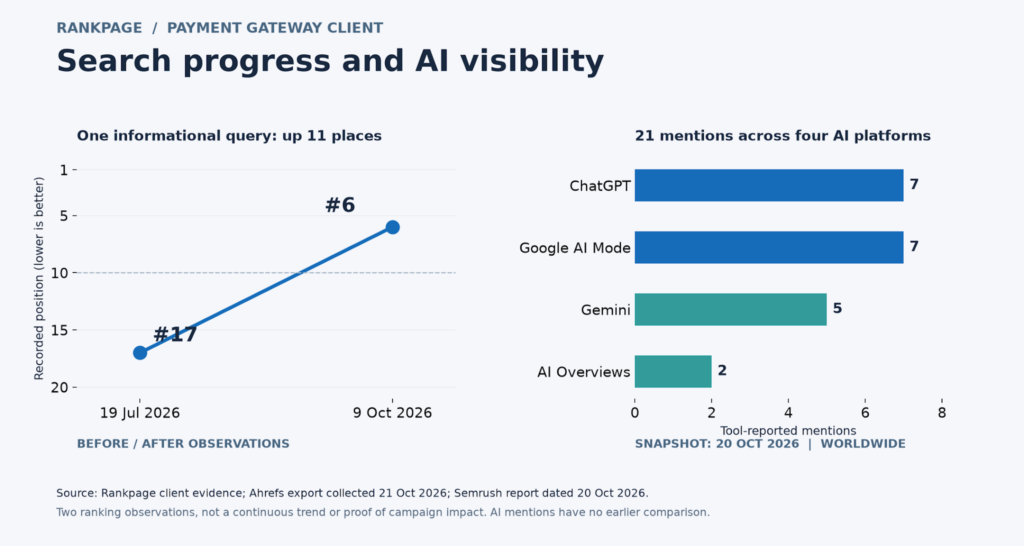
Figure: Two ranking observations alongside a separate snapshot of tool-reported AI mentions.
Source: Rankpage client evidence: anonymised Ahrefs export collected 21 October 2026 and Semrush worldwide snapshot dated 20 October. Tool-reported observations.
Common Mistakes in Fintech SEO
- Publishing thin, AI-generated explainers with no named author or review.
- Copying competitor feature lists, which gives Google nothing new to rank.
- Hiding licensing information in a footer link nobody finds.
- Letting old fee or rule information sit on live pages.
- Chasing the biggest keywords like “payment gateway” while ignoring specific, high-intent searches such as integration questions and industry-specific needs.
- Treating reviews and testimonials loosely. Only publish ones you can verify, and never write them yourself.
FAQ
Is fintech content always considered YMYL?
Mostly, yes. Content about payments, loans, investments, insurance or financial advice can affect someone’s money, so Google treats it with extra scrutiny. A page about your office culture is lower risk than a page explaining fees or security.
How do I improve E-E-A-T for a payment gateway website?
Show licensing details, name real authors and reviewers, date your content, publish clear company and contact information, and keep claims accurate. Build trust off-site too, through credible mentions and partnerships you can verify.
Does a payment gateway need a blog for SEO?
Not necessarily, but helpful content gives you more ways to appear in search. Guides, integration documentation and risk education capture searches that product pages can’t, and they show real expertise.
How long does SEO take for a fintech company?
It varies with competition, site health and how quickly changes go live. Many sites start seeing movement within a few months, but trust-focused sectors often need longer to build momentum.
Can AI tools like ChatGPT or Google AI Overviews recommend my payment gateway?
They can cite you if your content is clear, factual, consistent about your brand details and easy to extract. Self-contained answers and consistent company information give them something reliable to use.
Where to Start
SEO for payment gateways comes down to a simple idea: prove you’re trustworthy before you ask for the click. Start with an audit of your licensing information, author details, key product pages and technical basics. Fix what’s inaccurate, then build content around the questions merchants actually ask.
If you’d like outside help, Rankpage is a Malaysian SEO agency that works across SEO and AI search visibility, and it lists payment gateway providers among its client case studies. A short audit conversation is a low-pressure way to see where your site stands.
