I. What are Profinet and Modbus?
Profinet Technology
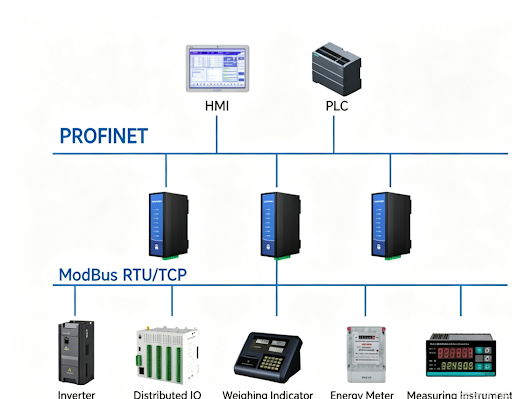
Profinet is an Industrial Ethernet fieldbus communication technology widely used in automated production lines and workshop control systems—particularly those based on Siemens PLCs. Characterized by high real-time performance and reliability, it is primarily used for high-speed control signal exchange between controllers and field devices, making it a mainstream industrial bus in industrial automation. Profinet utilizes Ethernet hardware for communication, enabling real-time control of field devices, parameter downloading, and status data acquisition by the controller.
Modbus Protocol
Modbus is a classic, universal communication protocol in the industrial sector, comprising two variants: Modbus RTU (serial) and Modbus TCP (Ethernet). It is supported by a vast array of sensors, instruments, variable frequency drives (VFDs), and remote I/O devices. While the Modbus protocol is simple, easy to use, and cost-effective to deploy—making it widely used for industrial data acquisition—it cannot communicate directly with Profinet networks; a protocol conversion device is required to facilitate data exchange between the two protocols.
II. Key Features of the PN1-D25PT Gateway
1. Bidirectional Protocol Conversion: Supports simultaneous conversion between Profinet and Modbus TCP/RTU. It allows switching between Modbus Master and Slave modes, enabling bidirectional data exchange between the two protocols.
2. High Device Compatibility: Compatible with the entire Siemens S7 series (S7-200, S7-300, S7-1200, S7-1500). It includes a GSDML configuration file and is compatible with TIA Portal and STEP7 configuration software.
3. Industrial-Grade Hardware Protection: Features an aluminum alloy housing and supports a wide DC power input range (8–28V). It offers multiple protections—including reverse polarity, electrostatic discharge (ESD), surge, and electrical fast transient (EFT) protection—along with both hardware and software watchdog timers.
4. Robust Load Capacity: Supports 48 communication command nodes in both Modbus TCP and RTU modes. In TCP Master mode, it features 8 independent sockets, allowing connections to up to 8 slave devices; in TCP Slave mode, it supports simultaneous access by up to 8 master devices. 5. Convenient Fault Diagnosis: Real-time monitoring of faults such as CRC errors, address errors, message anomalies, and link disconnections. Fault codes are uploaded via Profinet and indicated by panel alarm lights, enabling rapid localization of communication issues.
6. Flexible Configuration: Independent slot allocation for Modbus TCP and RTU functions; supports various message transmission modes (polling, level triggering, rising-edge triggering); customizable parameters for serial port delay, reconnection, and timeout.
III. PN1-D25PT Network/Interface Architecture
The PN1-D25PT is an industrial protocol conversion gateway featuring three network ports; the overall link structure is divided into two main sections: the Profinet network side and the Modbus communication side.
1. Profinet Side: Dual RJ45 ports with built-in switch functionality and 10/100M auto-negotiation; supports a minimum Profinet RT communication cycle of 4ms; connects to Profinet master devices such as PLCs and HMIs.
2. Modbus TCP Side: Independent network port with network isolation design to prevent network storms from interfering with the control network; connects to Modbus TCP Ethernet devices.
3. Modbus RTU Serial Side: RS485/RS422 compatible serial interface; baud rate range of 1200bps–3.9Mbps; configurable data bits, parity bits, and stop bits; connects to serial Modbus devices such as variable frequency drives (VFDs), instruments, and distributed I/O.
Note: The gateway handles protocol conversion—parsing and forwarding messages between Profinet and Modbus—without processing upper-layer business logic; business logic is managed by the PLC controller.
IV. Applicable Scenarios and Recommended Selection

The PN1-D25PT is designed to solve the field challenge of direct incompatibility between Profinet and Modbus devices. It eliminates the need to modify existing wiring or rewrite PLC programs, making it suitable for both new project setups and the retrofitting or upgrading of legacy production lines.
PN1-D25PT Gateway: Profinet-to-Modbus Protocol Conversion Gateway
Hardware features 35mm DIN-rail mounting; includes status indicators for power, communication, and faults; a “Reload” button supports system reboot, factory reset, and firmware upgrades; features complete isolation between the serial port and power supply; and complies with EU CE certification standards. Suitable for the following scenarios:
1. Automated production lines: Connecting Siemens PLCs (Profinet) with Modbus sensors, variable frequency drives (VFDs), distributed I/O, and actuators;
2. Photovoltaic power industry: Collecting data from inverters and smart meters and uploading it to Profinet control systems;
3. Chemical and water treatment industries: Integrating field Modbus instruments—such as those for temperature, pressure, and liquid level—into Profinet networks;
4. Retrofitting legacy production lines: Reusing existing Modbus equipment by connecting it to new Profinet control systems, thereby reducing retrofit costs.
Summary: The Ebyte PN1-D25PT gateway bridges the communication gap between Profinet and Modbus. Featuring industrial-grade hardware stability, simple configuration, and comprehensive fault diagnostics, it offers a cost-effective solution for achieving interoperability between these two protocols.
