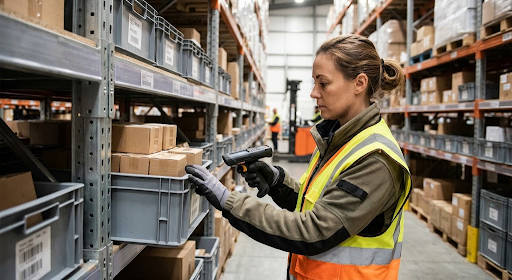
Cycle counting fails when a bin label, stock record, and physical items describe different things. Thermal labels can make each location and count event easy to scan, but the process must decide which identifier represents the bin and which represents the item or lot. A readable sticker is only one part of an accurate inventory count.
Separate location and stock identity
Give each shelf position or bin a stable location code. Put that code on the fixed rack, not on a movable tote that may travel elsewhere. Item and lot labels stay with the goods. When a counter scans the location, the system should show the expected stock and ask for a physical count. It should not silently accept the expected quantity as the observed number.
If a location contains more than one item, arrange the goods so each item or lot can be scanned without moving unrelated stock. Use large enough text to distinguish similar codes at arm’s length. A thermal warehouse label placed on the shelf edge should survive routine picking and cleaning for the planned period; otherwise, the location identity becomes unreliable between counts.
Record exceptions where they happen
When the observed quantity differs, capture the location, item, count, operator, and time before moving on. Mark suspect stock if the procedure requires a recount, but do not put a temporary exception sticker over the permanent location code. A second counter should be able to return to the same physical place and repeat the count. If the label itself is missing or unreadable, treat that as a maintenance issue rather than guessing the location from a neighboring shelf.
For movable containers, print a separate container ID. Link it to the location when stored and unlink it when moved. This avoids duplicate location labels on a rack and a tote. If a carton is opened or split, update the item quantity record before printing a new internal label.
Test a complete count route
Walk a sample route containing empty, mixed-item, and recently moved bins. Scan each label with the normal device and check whether it leads to the intended record. Measure first-pass reads and note where operators must stretch, rotate, or climb to reach a code. Better label placement can save more time than a faster printer.
Choose direct thermal labels whose image life fits the inventory interval. A bin code meant to last years may need a different construction from a short-lived count sticker. Keep the location naming rule and label replacement procedure documented so a damaged label is reissued from the system, not recreated by hand.
Deal with relabeled locations
Warehouse layouts change. If a rack is moved or a bin is split, retire the old location code in the inventory system before attaching a new one. Leaving two readable labels on the same bay can send counters to the wrong record. Do not reuse a retired code immediately for a distant shelf; old photographs and paper notes may still refer to it. Keep a simple move log with the old ID, new ID, date, and responsible person.
When a location label is damaged, reprint from the location master rather than typing the code. Check that the newly printed human-readable text and barcode lead to the same active record. During an audit, sample a few recently replaced labels because those are more likely to contain a transcription or placement error.
Use count data to fix the process
If discrepancies cluster in mixed-item bins, consider physical dividers or separate locations before adding more labels. If staff often cannot scan labels at the back of a shelf, move the code to a stable visible face. If errors occur after replenishment, review the put-away scan sequence. The label program should expose where inventory control breaks; it should not merely produce more stickers for every mismatch.
Decide what a label must survive
A fixed rack label may need to last through many cleaning cycles, while a temporary count marker may be used for a single shift. Specify those as different products if their exposure differs. Test the permanent code after routine cleaning and forklift contact points. If it repeatedly peels, a protected holder or a more durable print method may be better than reprinting the same paper label every week.
For temporary recount markers, make the status obvious and remove them after the exception closes. Old count stickers can be mistaken for current holds or newly counted locations. Keep them away from the permanent location code so a scanner has an unambiguous target.
Build a blind count check
In a sample area, hide the expected quantity from the first counter and record the observed count. A second person can review discrepancies without being anchored to the system number. Scan the location first and item second, then enter quantity. If the scanner accepts an item from a neighboring bin, the system should flag the mismatch. Test the workflow with two similar products next to each other.
Use the count results to identify physical problems. A recurring shortage in one mixed bin may require dividers or put-away changes. A recurring wrong-location scan may indicate that labels are placed too close together or hidden by stock. More labels are not necessarily the solution.
Maintain a change history
When a rack is renamed, moved, or split, record the old and new IDs and update the map before the next count. Reprint labels from the master record and verify them in place. This keeps historical count reports interpretable. Without a location history, a variance can look like a stock loss when goods were simply moved to a newly named position.
When a count is corrected, keep both the first observation and the approved final quantity in the record. The difference can show whether the cause was a missed bin, a mislabeled item, or a transaction posted late. Reprinting a shelf label should never erase that history or make the variance appear to have vanished.
A small monthly maintenance sample
Each month, scan a few high-traffic and low-traffic location labels. Look for abrasion, old duplicate codes, and labels hidden by new stock. Replace damaged labels from the location master and verify the replacement in place. This maintenance sample keeps the counting route trustworthy between formal audits and reveals locations whose physical layout needs improvement.
