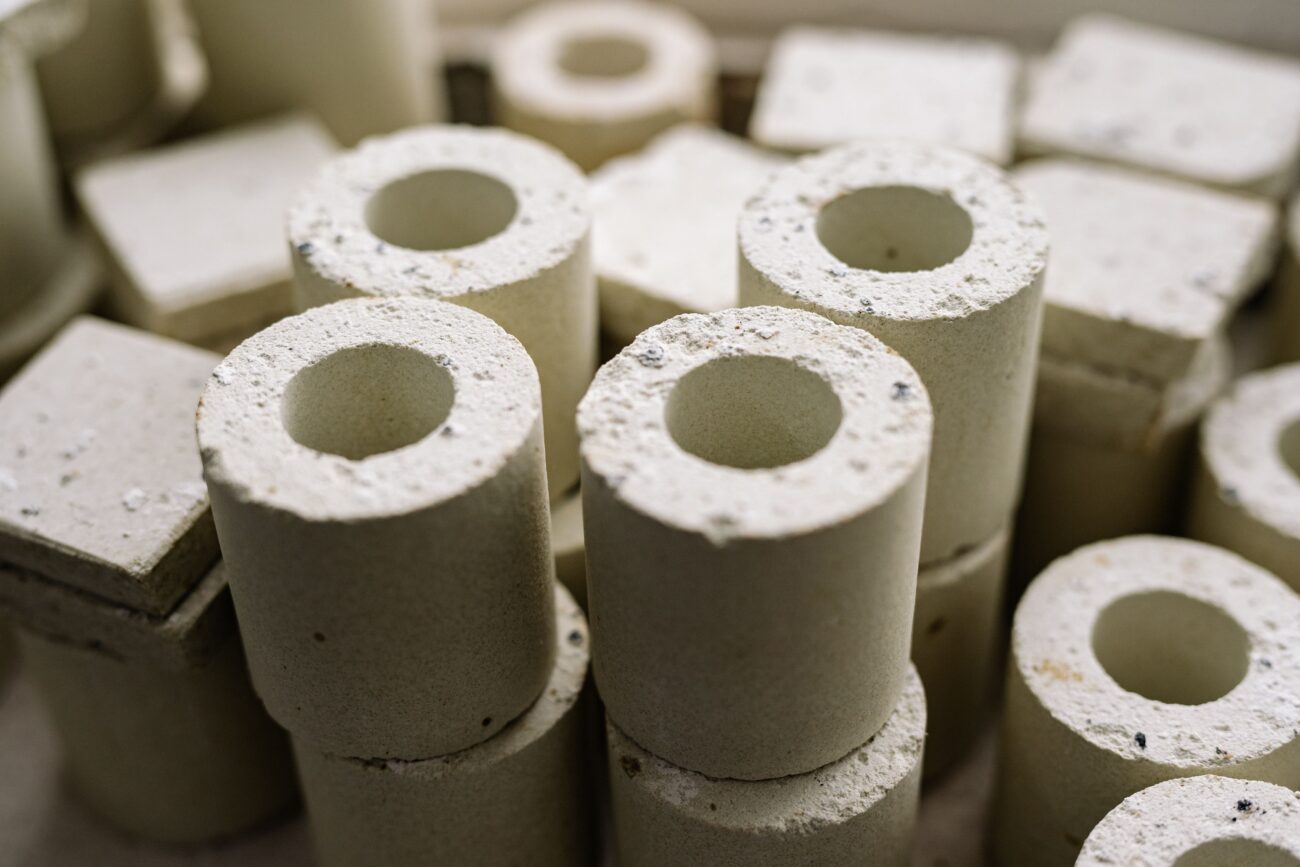
Same ceramic, very different job.
An alumina ceramic that works well as a furnace liner may need a very different specification when used as an electrical insulator, circuit substrate, or wear barrier. The right choice depends less on simply asking for “alumina” and more on matching purity, temperature capability, electrical behavior, hardness, geometry, and surface condition to what the component will actually face.
Imagine two alumina plates sitting on the same engineering desk. They look almost identical. One is going into a high-temperature furnace assembly. The other will separate electrically active components.
Ordering both from the same generic material specification sounds convenient. It can also create two completely different failure risks.
The useful question is not “Is alumina suitable?” It is “What does alumina need to do in this particular application?”
That is where a good specification starts.
Alumina, or aluminum oxide (Al₂O₃), is available in many technical ceramic compositions. CoorsTek, for example, lists alumina grades ranging from about 80% to more than 99% Al₂O₃ and says to select the grade for the application environment. Stanford Advanced Materials offers alumina products in several compositions, including 95%, 97%, 99%, and 99.7% Al₂O₃.
So before choosing a purity percentage, define the job.
What Actually Changes When Alumina Is Used in Different Applications?
Almost every important selection priority can change.
- For a furnace liner, temperature and thermal cycling may dominate the decision.
- For an electrical insulator, volume resistivity, dielectric behavior, geometry, and operating temperature take priority.
- For a circuit substrate, thermal conductivity, electrical insulation, flatness, surface quality, and thickness can become critical.
- For a wear barrier, the engineer cares more about hardness, abrasion, impact, thickness, and how the ceramic attaches to the supporting structure.
A practical way to think about the specification is:
Operating environment → likely failure mode → required properties → alumina grade → geometry → tolerances
That sequence is much safer than starting with purity alone.
Which Alumina Properties Matter Most?
Alumina is popular because several useful properties appear in the same material family: high hardness, electrical insulation, good temperature capability, corrosion resistance, and reasonable thermal conductivity.
But those properties vary by composition.
For example, Stanford Advanced Materials lists density values from about 3.7 g/cm³ for 95% alumina to 3.92 g/cm³ for 99.7% alumina. Listed Vickers hardness rises from about 13.8 GPa to 18 GPa, while thermal conductivity increases from roughly 25 to 30 W/(m·K) across those grades.
CoorsTek shows the same broader trend across its own alumina compositions. Its published room-temperature thermal conductivity ranges from about 22.4 W/m·K for nominal 94% alumina to 33 W/m·K for minimum 99.9% alumina.
The numbers matter, but only when they are connected to the application.
| Property | Why It Matters | Most Relevant Applications |
| Alumina content | Influences electrical, thermal, wear, and chemical behavior | All four |
| Working temperature | Helps define thermal suitability | Furnace liners |
| Thermal expansion | Affects stress and dimensional change during heating | Furnace liners, substrates |
| Thermal conductivity | Controls heat movement through the ceramic | Circuit substrates |
| Volume resistivity | Indicates resistance to electrical current | Insulators, substrates |
| Dielectric strength | Helps determine electrical isolation capability | Electrical insulators |
| Hardness | Supports abrasion resistance | Wear barriers |
| Fracture toughness | Helps indicate resistance to crack propagation | Wear barriers, loaded components |
| Surface finish | Influences bonding, electrical behavior, and circuit processing | Insulators, substrates |
| Thickness and geometry | Affect stress, heat transfer, electrical path, and fit | All four |
The table gives you the map. Now the individual applications tell you which road to take.
How Should Alumina Be Specified for Furnace Liners?
For furnace service, the obvious first question is temperature.
It should never be the only one.
SAM lists working temperatures of approximately 1,500°C for 95% alumina, 1,600°C for 97%, and 1,650°C for its 99% and 99.7% grades on its current alumina product data.
Those values show why alumina is considered for high-temperature service. They do not tell you whether a specific plate will survive your exact heating cycle.
Start With the Real Furnace Conditions
Before choosing a grade, define:
- Normal operating temperature
- Maximum temperature
- Heating rate
- Cooling rate
- Frequency of thermal cycling
- Furnace atmosphere
- Chemical or vapor exposure
- Mechanical loading
- Support points
- Plate size and thickness
A plate that remains at 1,300°C for several hours experiences a different stress history from a plate that repeatedly moves between room temperature and 1,300°C.
Both see the same peak temperature. They do not see the same service.
That distinction matters because alumina is hard and thermally stable, but it is still a brittle ceramic. High maximum temperature does not automatically mean unlimited resistance to rapid temperature change.
Thermal Expansion Can Affect the Whole Assembly
SAM lists coefficients of thermal expansion near 7.7 to 7.8 × 10⁻⁶/°C for its alumina grades. CoorsTek reports about 8.2 × 10⁻⁶/°C between 25°C and 1,000°C for several of its alumina compositions.
That becomes important when alumina is mounted inside a metal frame or supported by another material.
If two materials expand differently while heating, a rigid mounting system can create additional stress. Gaps, joints, support points, plate dimensions, and mounting details may therefore matter as much as the alumina purity itself.
A Better Furnace Specification
Instead of writing:
Material: Alumina
give the supplier enough information to understand the service:
- Required alumina grade or minimum purity
- Operating and peak temperature
- Furnace atmosphere
- Thermal cycling conditions
- Plate dimensions
- Thickness
- Support arrangement
- Surface requirements
- Critical tolerances
Now the material choice has context.
What Matters Most for Alumina Electrical Insulators?
Electrical insulation changes the decision completely.
The question shifts from abrasion or maximum furnace temperature to how effectively the ceramic isolates voltage under real operating conditions.
Dense alumina grades can provide very high electrical resistivity. SAM lists room-temperature volume resistivity above 10¹⁴ ohm-cm for its 95%, 97%, 99%, and 99.7% grades. CoorsTek reports similarly high room-temperature values across several technical alumina compositions.
That looks impressive, but engineers should not miss an important detail.
Electrical Properties Change With Temperature
CoorsTek’s data shows volume resistivity falling considerably as temperature increases.
For example, several of its alumina grades that exceed 10¹⁴ ohm-cm at 25°C show values roughly between 10⁹ and 10¹² ohm-cm at 500°C, depending on composition.
So if an electrical insulator operates beside a heating element or inside a hot process chamber, room-temperature data alone may not describe actual performance.
That is a much more useful specification question:
What is the electrical requirement at operating temperature?
Geometry Also Becomes Part of the Insulation System
A material can have excellent dielectric properties and still perform poorly if the geometry is wrong.
Relevant details may include:
- Plate thickness
- Hole position
- Edge radii
- Distance between conductors
- Creepage path
- Surface finish
- Operating voltage
- Frequency
- Maximum temperature
- Environmental contamination
- Mechanical loading
In electrical applications, the ceramic and the component shape work together.
What Changes When Alumina Becomes a Circuit Substrate?
Electronic substrates have to solve two jobs that seem contradictory.
They need to electrically isolate conductive features while still helping heat move away from components.
That makes thermal conductivity, dielectric behavior, flatness, surface finish, and dimensional control especially important.
CoorsTek describes alumina as a common material for thin-film and thick-film ceramic substrates and highlights factors such as surface finish, grain size, thickness, tolerancing, edge finishing, and inspection.
Thermal Conductivity Is Only Part of the Thermal Story
SAM lists thermal conductivity around 25 W/(m·K) for its 95% and 97% alumina compositions and about 30 W/(m·K) for the 99% and 99.7% grades.
Higher thermal conductivity can help move heat through the ceramic, but the actual thermal path also depends on:
- Substrate thickness
- Contact area
- Interface materials
- Metallization
- Bonding layers
- Component footprint
- Cooling method
A better bulk material cannot compensate for a poor thermal interface elsewhere in the assembly.
Surface Condition Can Become a Functional Requirement
This is where substrate specification differs from a simple structural ceramic plate.
CoorsTek notes that surface finish, grain size, and surface imperfections matter in thin-film substrates because they affect fine-line resolution, spacing, and process yield.
For a circuit substrate, an RFQ may therefore need to include:
- Alumina composition
- Thickness
- Thickness tolerance
- Flatness
- Surface roughness
- Edge condition
- Hole or slot geometry
- Electrical requirements
- Thermal requirements
- Intended metallization or downstream process
In other words, “99% alumina” may tell you the chemistry. It does not tell you whether the finished substrate works in the process.
How Should Alumina Be Specified for Wear Barriers?
Now the priority shifts again.
In a wear application, hardness becomes much more important.
SAM lists Vickers hardness values of about 13.8 GPa for 95% alumina and 18 GPa for 99.7% alumina.
CoorsTek also markets alumina compositions specifically for wear applications and notes their abrasion and corrosion resistance in material-handling environments.
Still, choosing the hardest grade is not enough.
First Identify the Wear Mechanism
A chute carrying fine powder does not experience the same damage as equipment taking direct hits from large particles.
Wear may come from:
- Sliding abrasion
- Particle erosion
- Repeated impact
- Gouging
- Corrosive attack
- A combination of several mechanisms
Hardness helps resist abrasive material removal.
Impact introduces another problem.
Alumina is hard but brittle, so a design exposed to concentrated impact may require more attention to plate thickness, backing support, joint design, geometry, and potentially a tougher ceramic system.
Thickness Is Not a Universal Number
No single “best” alumina wear-liner thickness exists.
The appropriate value depends on factors such as:
- Particle size
- Particle velocity
- Impact energy
- Plate dimensions
- Backing material
- Mounting method
- Expected wear life
- Available installation space
Making the plate thicker without understanding the failure mode can add cost and weight without fixing the actual problem.
Installation Matters Too
Ceramic wear barriers usually operate as part of a larger lining system.
The engineer may need to consider:
- Adhesive bonding
- Mechanical fasteners
- Backing material
- Tile layout
- Joints
- Edge exposure
- Curved surfaces
- Replacement access
A ceramic plate can be very hard and still fail early if particles repeatedly strike an unsupported edge.
That is not a bad material. It is a bad system design.
Need an Alumina Plate for a Specific Operating Condition?
Once you know the required purity, dimensions, temperature range, electrical conditions, or wear environment, you can compare available alumina plate options from Stanford Advanced Materials (SAM). Sharing the application conditions and drawing can also make the specification discussion much more useful than selecting a grade from purity alone.
One Alumina Material Family, Four Different Decisions
Once you place the four applications side by side, the specification logic becomes much clearer.
| Requirement | Furnace Liner | Electrical Insulator | Circuit Substrate | Wear Barrier |
| Main job | Survive high-temperature service | Electrically isolate components | Support circuits while managing electrical and thermal needs | Resist abrasive material loss |
| Start by defining | Temperature and thermal cycle | Voltage and operating temperature | Electrical load and thermal path | Wear mechanism and impact |
| Critical properties | Thermal stability, CTE, chemical resistance | Resistivity, dielectric performance | Thermal conductivity, dielectric behavior | Hardness, wear resistance |
| Geometry concerns | Support, thickness, expansion | Thickness, creepage, edges | Flatness, thickness, finish | Thickness, edges, attachment |
| Easy mistake | Choosing by max temperature only | Using room-temperature data only | Choosing by purity alone | Choosing by hardness alone |
The pattern is simple: each application creates a different definition of “good alumina.”
Does Higher Alumina Purity Automatically Mean Better Performance?
No.
Higher alumina content can improve several properties, but the highest purity is not automatically the best choice for every application.
CoorsTek notes that alumina materials come in a broad range of compositions and that grades are selected based on the application environment. Its property data also shows higher thermal conductivity and hardness in several higher-purity compositions.
SAM’s data shows a similar trend. Its listed hardness rises from 13.8 GPa for Al95 to 18 GPa for Al997, while thermal conductivity rises from 25 to 30 W/(m·K).
But a lower-purity grade may still meet the actual electrical, thermal, mechanical, and environmental requirements.
If it does, specifying the highest purity simply because the number looks better may not add meaningful engineering value.
A better question is:
Which grade satisfies the critical requirements with an appropriate safety and performance margin?
What Should Go Into an Alumina RFQ?
Once the engineering requirements are clear, the purchasing specification becomes much easier to write.
Include the details that can actually change material or manufacturing decisions:
- Application
- Desired alumina grade or purity, if known
- Length, width, and thickness
- Holes, slots, or other features
- Critical dimensional tolerances
- Surface finish
- Normal operating temperature
- Maximum temperature
- Atmosphere or chemical exposure
- Electrical requirements
- Mechanical loading
- Wear conditions
- Quantity
- Drawing
- Inspection requirements
Not every application needs every field.
That is the point.
A good RFQ describes the job instead of filling out a generic ceramic checklist.
Common Alumina Specification Mistakes
Choosing From Purity Alone
Purity matters, but it does not describe thermal cycling, geometry, finish, impact, or electrical service temperature.
Looking at One Property in Isolation
Maximum temperature does not describe furnace reliability.
Hardness does not describe impact resistance.
Room-temperature resistivity does not describe hot electrical performance.
Each number needs context.
Ignoring the Finished Geometry
A technically suitable alumina composition can still become a poor component if sharp corners, poor support, insufficient thickness, incorrect flatness, or inappropriate mounting create a new failure mode.
Treating Datasheet Values as Universal
Material-property values depend on composition, manufacturing process, test method, and temperature.
SAM itself notes on its alumina product data that published values are reference data and that actual specifications can vary.
Use datasheets to make engineering decisions, not to avoid them.
Frequently Asked Questions
What alumina purity should I use?
Use the grade that meets your application’s thermal, electrical, mechanical, chemical, and wear requirements. SAM currently lists common alumina compositions including 95%, 97%, 99%, and 99.7% Al₂O₃.
Higher purity can improve some properties, but you shouldn’t select it automatically.
Is 99% alumina better than 95% alumina?
Not in every application.
SAM’s current data shows higher hardness, thermal conductivity, and working temperature for its 99% grade compared with its 95% grade. However, those gains only matter if the application actually needs them.
Is alumina suitable for furnace liners?
Alumina can be suitable for high-temperature furnace applications because of its thermal stability and temperature capability. The final specification should also consider furnace atmosphere, thermal cycling, support conditions, geometry, and mechanical stress.
Why is alumina used for electrical insulation?
Alumina combines high electrical resistivity with useful mechanical and high-temperature properties. Several commercial alumina compositions show room-temperature volume resistivity above 10¹⁴ ohm-cm.
Why is alumina commonly used for electronic substrates?
It can provide electrical insulation, useful thermal conductivity, dimensional stability, and a surface suitable for electronic processing. CoorsTek lists alumina as a common choice for both thin-film and thick-film ceramic substrates.
How thick should an alumina wear barrier be?
There is no universal thickness. It depends on particle size, velocity, impact, backing support, plate size, installation method, expected service life, and available space.
Specify the wear environment first. Thickness follows from that.
The Better Alumina Specification Starts With the Application
A furnace liner, electrical insulator, circuit substrate, and wear barrier may all be made from alumina, but they should not be specified as though they are the same component.
For furnace service, temperature, atmosphere, thermal cycling, and support geometry lead the decision. Electrical insulation prioritizes resistivity, dielectric behavior, temperature, and geometry. Circuit substrates add thermal conductivity, surface condition, flatness, and process compatibility. Wear barriers bring hardness, abrasion mechanism, impact, thickness, and attachment into focus.
Once you define those conditions, selecting an alumina ceramic grade becomes far less confusing.
And if two alumina options still look almost identical on the datasheet, ask one simple question: which one better matches what the part will actually go through every day?
