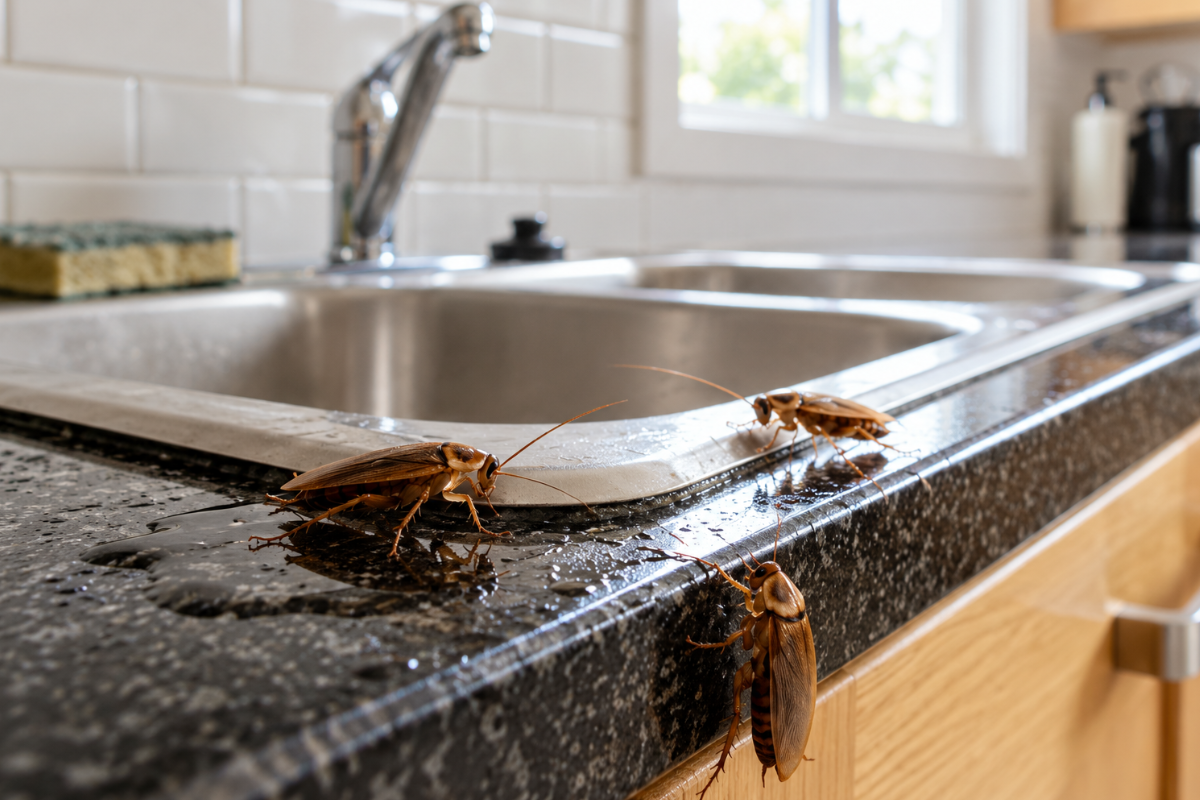
Cockroaches are among the most persistent pests you can encounter in a home. They reproduce quickly, hide in places that are difficult to reach and can survive in conditions that would be unsuitable for many other insects. Once you start seeing them in the kitchen, bathroom or other areas of the house, it is important to act quickly.
If you want to get rid of cockroaches, there is rarely a single product or one-time treatment that solves the entire problem. Effective cockroach control usually requires a combination of monitoring, targeted insecticide application, sanitation and follow-up treatments.
The first step is understanding where the cockroaches are coming from, where they hide and which areas they use most frequently.
Start with monitoring and inspection
Before applying any insecticide, it is important to establish the extent of the infestation. One of the most common mistakes is to start treating immediately without first identifying where cockroaches are active.
Glue traps are one of the simplest tools for monitoring cockroach activity. They can be placed in strategic locations such as inside kitchen cabinets, underneath sinks, behind or beside refrigerators, near cooking appliances and in bathrooms.
These traps are not primarily designed to eliminate an established infestation. Their main purpose is to show you where cockroaches are moving and how significant the activity is.
If several cockroaches are caught in one trap while others remain empty, this can provide useful information about where the main activity is concentrated. Traps can then be repositioned to investigate other areas and identify possible movement routes.
Regular monitoring can also be useful after treatment. If cockroach activity starts increasing again, it may indicate that additional treatment or investigation is needed.
In homes without a recent history of infestation, occasional inspections can help detect problems early. Properties that have previously experienced cockroach activity may benefit from more frequent monitoring.
Cockroach gel bait: A targeted tool for hidden infestations
One of the most useful tools for cockroach control does not involve spraying an entire room. Insecticide gel baits work by attracting cockroaches to feed on the bait.
The gel contains food-based attractants and an insecticidal active ingredient. After feeding, cockroaches return to their hiding places, where the bait can contribute to further mortality within the population, depending on the formulation and cockroach behaviour.
This makes gel particularly useful for areas where cockroaches spend most of their time but where conventional spraying may be difficult or undesirable.
Gel is normally applied in small spots rather than large amounts. Suitable locations may include:
- Behind and underneath kitchen appliances
- Inside cabinets and cupboards
- Around pipes and service openings
- Near cracks and crevices
- Under sinks
- Around equipment and furniture
- In other sheltered areas where cockroach activity has been detected
Before applying gel, it is useful to remove competing food sources and keep the surrounding area clean. If plenty of alternative food is available, cockroaches may be less likely to feed on the bait.
Gel should also be inspected regularly and replaced or reapplied according to the product instructions and the level of activity.
Ready-to-use cockroach insecticides
For larger surface areas or situations where a targeted gel application is not enough, ready-to-use insecticides can be another option.
RTU, or ready-to-use, products do not require dilution or preparation, making them convenient for targeted applications. Depending on the formulation, they can provide contact activity, residual control or both.
Not every product works in exactly the same way. Some formulations are designed primarily to control active cockroaches, while others may contain insect growth regulators that interfere with the development and reproduction of immature insects.
This distinction can be important when dealing with an established infestation. Killing visible adult cockroaches may reduce activity temporarily, but immature stages can continue developing if they are not addressed by the treatment strategy.
When choosing an insecticide, look at the active ingredient, mode of action, target pests, application sites and any restrictions on use rather than relying only on the product format.
Combining spray treatments with aerosols
A targeted residual spray can be applied to appropriate surfaces where cockroaches travel or hide, such as cracks, crevices, skirting boards, areas behind furniture and spaces around pipes and equipment.
Depending on the product and treatment protocol, an aerosol application may then be used to help reach insects in difficult areas or flush them from certain hiding places.
The two methods have different roles. A residual spray deposits insecticide on treated surfaces, while an aerosol can help distribute the active ingredient into areas that are difficult to reach directly.
However, these methods should not automatically be combined. Some products are incompatible with baiting, while others require specific ventilation, re-entry or application conditions. Always follow the instructions on the label and use only products approved for the intended application.
Insecticide dust for hard-to-reach areas
Insecticide dust can be another useful tool, particularly in areas where liquid products are difficult to apply.
Dust formulations can be used in suitable cracks, voids and other inaccessible areas where cockroaches are likely to travel. When insects move through the treated dust, particles can adhere to their bodies and contribute to exposure.
This makes dust useful for locations such as:
- Wall voids
- Service openings
- Certain cracks and gaps
- Areas around pipes
- Suitable electrical or utility voids, where the product label specifically permits such use
Dust should be applied as a thin, controlled layer. More product does not necessarily mean better results. Heavy piles of dust can actually discourage insects from crossing the treated area.
It is also important to use only products specifically labelled for the intended location. Applying insecticide dust inside electrical components or other sensitive areas without explicit label approval can create unnecessary safety risks.
If dust is used alongside liquid insecticides, the treated surfaces should be completely dry where required by the product instructions.
Common mistakes that can undermine cockroach control
Even good products can produce disappointing results when they are used incorrectly.
Treating only once
Cockroach infestations often involve several life stages, and eggs or immature insects may remain after the first treatment. Depending on the product and infestation, follow-up inspections and applications may therefore be necessary.
A reduction in visible activity does not automatically mean that the infestation has been eliminated.
Treating only visible surfaces
Cockroaches usually spend much of their time hidden. They may shelter behind refrigerators, under sinks, inside cabinets, around pipes or in cracks and voids.
Spraying only the open floor or visible parts of the kitchen may leave the main hiding places untreated. Effective treatment starts with identifying these areas and directing control measures towards them.
Leaving food and water readily available
Sanitation is an important part of cockroach control. Food crumbs, grease, standing water, overflowing bins and accessible food storage can all support an infestation.
Keeping food in sealed containers, cleaning spills quickly, removing rubbish regularly and fixing leaks can make the environment less favourable for cockroaches.
This is particularly important when using gel bait. Reducing alternative food sources can help make the bait more attractive.
Using too much insecticide
More insecticide does not automatically mean better control. Excessive application can create unnecessary exposure, damage surfaces or interfere with bait placement.
The objective should be targeted application in the areas where cockroaches are active, using the correct amount specified by the product label.
A more effective approach to cockroach control
If you want to get rid of cockroaches, the most reliable approach is to think beyond a single product.
Start by monitoring the property and identifying areas of activity. Use glue traps to establish movement patterns, then select the appropriate control method based on the infestation.
Gel bait can be particularly useful in cracks, cabinets, behind appliances and other sheltered areas. Targeted residual insecticides can address cockroaches moving across treated surfaces, while insecticide dust can be considered for suitable hard-to-reach voids.
Sanitation and exclusion should run alongside insecticide treatment. Removing food and water sources, reducing clutter, sealing cracks and addressing leaks can make it much harder for cockroaches to survive and reproduce.
