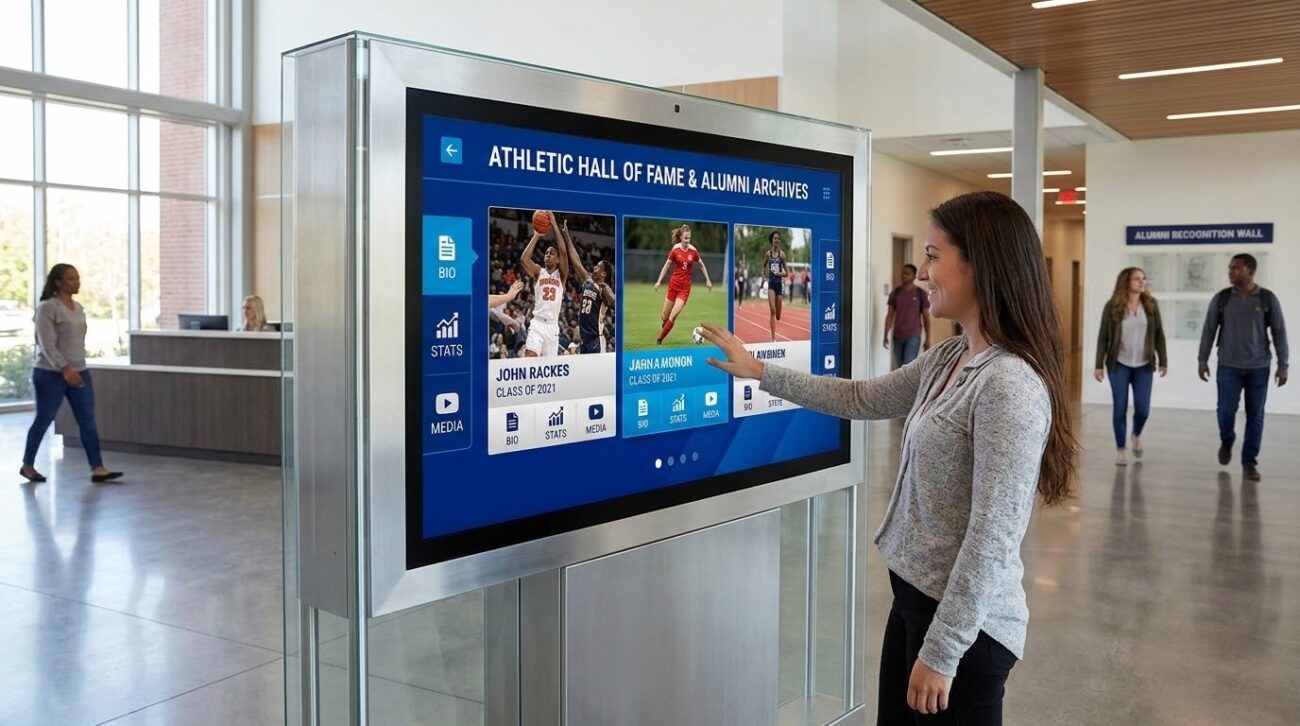
Walk the hallways of American high schools, colleges, and sports venues, and the change is hard to miss. Dusty wooden trophy cases and static brass plaques are giving way to colorful, interactive screens.
Better still, today’s recognition platforms connect the physical lobby touchscreen with mobile and web archives. Alumni can watch a game-night display in the lobby, then open the same virtual archive on a phone at home. Donors and fans can celebrate legends and benefactors from anywhere.
Connecting on-site displays with online portals turns a local tribute into a living, searchable digital archive. If your school, athletic department, or nonprofit is ready to celebrate its heritage, these seven digital hall of fame tools lead the way.
Why Lobby Screens Need Online Archives
A lobby kiosk captures attention on campus. A connected web and mobile archive keeps that story available after visitors leave.
Together, they let staff update one honoree record and see it appear on the hallway screen and on a phone. That is what turns a one-time installation into a lasting recognition system.
Platform Snapshot
| Platform | Best for | Staff needed | Watch-out |
| Touchstone | A custom hall of fame, donor wall, and team wall tied to web archives | Non-technical staff with vendor support | Fully managed custom build, not a DIY template |
| Digital-Trophy-Case.com | A searchable honoree kiosk with bundled hardware | Staff who want a simple directory | Less room for custom storytelling |
| Rise Vision | A basic recognition board on an existing campus signage network | Communications or IT already using the platform | Templates lack a deep honoree archive |
| PandaSuite | Creative teams that want the same experience on kiosk and mobile | Design-savvy staff | You build the hall of fame structure from scratch |
| Intuiface | Rich, multi-layered exhibits that link touchscreens to the web | Technical staff or an integrator | Dedicated design hours to build the directory |
| Norvision | Donor walls and giving societies | Advancement or development staff | Built for philanthropy, not athletic halls of fame |
| Nevco | A Wall of Fame that matches existing scoreboard branding | Athletic facilities teams | More hardware-focused than archive-focused |
1. Touchstone Digital Solutions
For institutions that want a fully personalized showcase, Touchstone Digital Solutions stands out as the premier custom builder.
The team does not force a school into a rigid template. It designs the visual identity, content structure, and interactive experience around that institution’s history.
Key Strengths
- Turnkey installations cover athletic halls of fame, donor recognition, and team walls.
- An accessible content management system lets non-technical staff update records.
- Dedicated ongoing support keeps the interactive kiosk in sync with web archives.
- Honoree stories can live on a lobby touchscreen and in a public digital archive at the same time.
That mix of custom design and simple updates is what makes Touchstone a strong fit for schools and nonprofits that want heritage treated as more than a slide deck on a screen.
2. Digital-Trophy-Case.com
Digital-Trophy-Case.com is a practical, hardware-focused option for organizations that want a touchscreen kiosk without a long custom build. Displays typically range from 43 to 65 inches.
Key Strengths
- Cloud-based directories let visitors search honoree bios, team rosters, and championship photos.
- The interface is built around a searchable index rather than a complex exhibit.
- It is a straightforward fit for sports facilities and community centers that need an organized honoree list.
The trade-off is depth. This format works well as a directory. Institutions that want rich video biographies, custom visual identity, or layered storytelling may find it more limited than a purpose-built hall of fame platform.
3. Rise Vision
Rise Vision is an established cloud signage platform used across many American school districts. It is known for multi-device access and everyday campus communication.
Key Strengths
- Administrators can push updates across hallway screens, classroom displays, and connected web portals in seconds.
- The template library includes straightforward recognition boards.
- It is an accessible entry point if the school already uses Rise Vision for announcements and alerts.
The limitation is the same one schools see with generic signage tools. Recognition boards can show names and photos, but they rarely offer a deep, searchable hall of fame structure. Rise Vision is strongest when a simple tribute screen needs to join an existing campus network.
4. PandaSuite
PandaSuite fits teams that want full hands-on control without writing code. It is a flexible drag-and-drop workspace for layouts, transitions, and animation.
Key Strengths
- One canvas can power on-site kiosks and mobile browsers.
- Visitors can get the same browsing experience in the lobby or on the go.
- Creative departments get an open-ended builder instead of a fixed template.
PandaSuite started as a general interactive app builder, not a hall of fame product. Staff still need to design honoree databases, navigation, and archive logic themselves. That freedom is useful, but the ongoing design work stays in-house.
5. Intuiface
Schools and organizations with in-house multimedia talent often gravitate toward Intuiface. It is an enterprise-grade, no-code signage platform known for rich interaction.
Key Strengths
- It supports touch navigation, high-definition video, sensor inputs, and external database connections.
- Technical teams can build multi-layered exhibits that link physical touchscreens to web experiences.
- It is a strong choice for a high-impact lobby centerpiece.
It does require dedicated design hours to set up an honoree directory. Without that investment, Intuiface remains a powerful signage engine rather than a ready-made digital hall of fame.
6. Norvision
When philanthropic milestones and alumni contributions are the central goal, Norvision offers a donor recognition platform built for giving programs of all sizes.
Key Strengths
- Interactive displays are designed to deepen community engagement around giving.
- It can highlight donor levels and support capital campaign launches.
- Physical donor walls can connect with digital giving platforms.
Norvision is at its best as a stewardship tool. It is not built around athletic rosters, championship archives, or hall of fame induction classes. Schools that need both a donor wall and a sports hall of fame may need a second platform, or one system that covers both.
7. Nevco
If a high school gymnasium or college arena already has a Nevco scoreboard, a matching digital Wall of Fame can sit naturally in that same facility brand. Nevco offers commercial displays from 55 to 85 inches, in wall-mount, floor-stand, and enclosure styles.
Key Strengths
- It fits an athletic department’s existing arena ecosystem.
- Retired jerseys, state championships, and hall of fame honors can appear in the home venue.
- Hardware options are built for gym and arena environments.
Nevco is first a scoreboard and facility-branding manufacturer. The Wall of Fame offering is more hardware-led than archive-led. Programs that need a searchable web archive, donor tiers, and frequent software updates may still want a recognition-focused CMS alongside the display.
What to Look for in a Digital Recognition System
The best platform is the one your staff can actually keep current.
Look for:
- A user-friendly content management system, so any staff member can upload photographs, biographies, and newspaper clippings without IT support.
- Mobile and cloud responsiveness, so honoree profiles look as strong on an iPhone or laptop as they do on a 65-inch 4K touchscreen.
- A clear plan for who will add new inductees after opening night.
If those three pieces are missing, even a beautiful lobby screen will fall behind the next season’s story.
Bring Your History to Life
Your community’s greatest achievements should not stay locked in a cabinet. An interactive lobby kiosk, paired with an accessible mobile and web archive, creates a legacy that supporters can reach from anywhere.
Which recognition tool fits your institution’s vision best? Reach out to start honoring your community heroes today.
