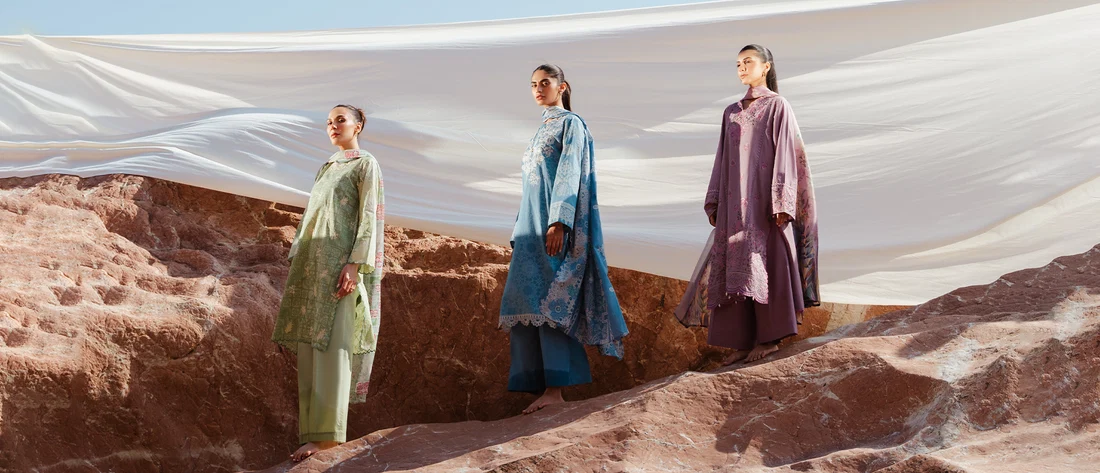
Pakistani fashion has spent the last few years building international attention, and this year that momentum has translated into a noticeably different look on runways, in lawn collections, and in what women are actually reaching for in their closets. A few clear shifts are driving that change.
Quiet Luxury Replaces Maximalism
The heavily embellished, all-over embroidered look that dominated formal wear for years is giving ground to something calmer. Designers are leaning into clean tailoring, considered detailing, and fabrics that speak for themselves instead of relying on volume of embellishment to signal quality. It’s less about how much work is on a piece and more about how well it’s cut.
Two-Piece Co-Ords Take Over From Three-Piece Suits
The traditional three-piece suit, shirt, trouser, and dupatta, is losing ground to two-piece coordinated sets for everyday and office wear. Dropping the dupatta for daily errands or a workday makes the outfit easier to move in, and the coordinated set still reads as polished without the extra layer to manage.
Prints Are Getting Bolder Where They Do Show Up
Where prints are still the focus, especially in lawn, they’re going in the opposite direction from the quiet-luxury trend: bigger florals, more abstract patterns, and designs that draw the eye rather than blending into a crowd of similar pieces. It’s a split that makes sense once you separate categories, restrained where the fabric itself carries the piece, louder where print is the entire point.
Earthy Tones and Soft Pastels Dominate the Palette
Olive, rust, stone beige, powder pink, and deep blue are showing up across both stitched and unstitched collections this year, replacing some of the brighter jewel tones that dominated past festive seasons. These shades photograph well, work across skin tones, and pair easily with the simpler silhouettes trending alongside them.
Embroidery Moves to the Borders
Even in festive and bridal wear, embroidery is increasingly concentrated along borders, necklines, and hemlines rather than spread across the entire garment. The effect is a piece that still reads as special-occasion without the weight, both literal and visual, of full embellishment, which also makes these outfits far more comfortable to wear for long hours at a wedding or event.
Where Heritage Houses Fit Into the Shift
Established names haven’t sat this shift out. A brand like Maria B, known for decades of detailed embroidery and seasonal lawn collections, has room to lean into cleaner cuts and more restrained detailing each season while still drawing on the craftsmanship that built its reputation in the first place. That’s part of what’s made this year’s trend cycle feel like an evolution rather than a break from what came before.
Sustainability Is No Longer Optional
More brands are being asked, and are answering, questions about fabric sourcing and production practices. Cotton and linen are gaining ground partly because they’re comfortable in Pakistan’s climate and partly because they hold up better against sustainability scrutiny than synthetic alternatives, a conversation that’s become far louder among younger shoppers than it was even a couple of years ago.
What This Means for Building Your Own Wardrobe
None of these trends require replacing your entire closet. A couple of well-cut two-piece sets, one or two pieces in this year’s palette, and a festive outfit with border-focused embroidery instead of all-over work will carry you through most of what the season calls for, without chasing every micro-trend that shows up online.
