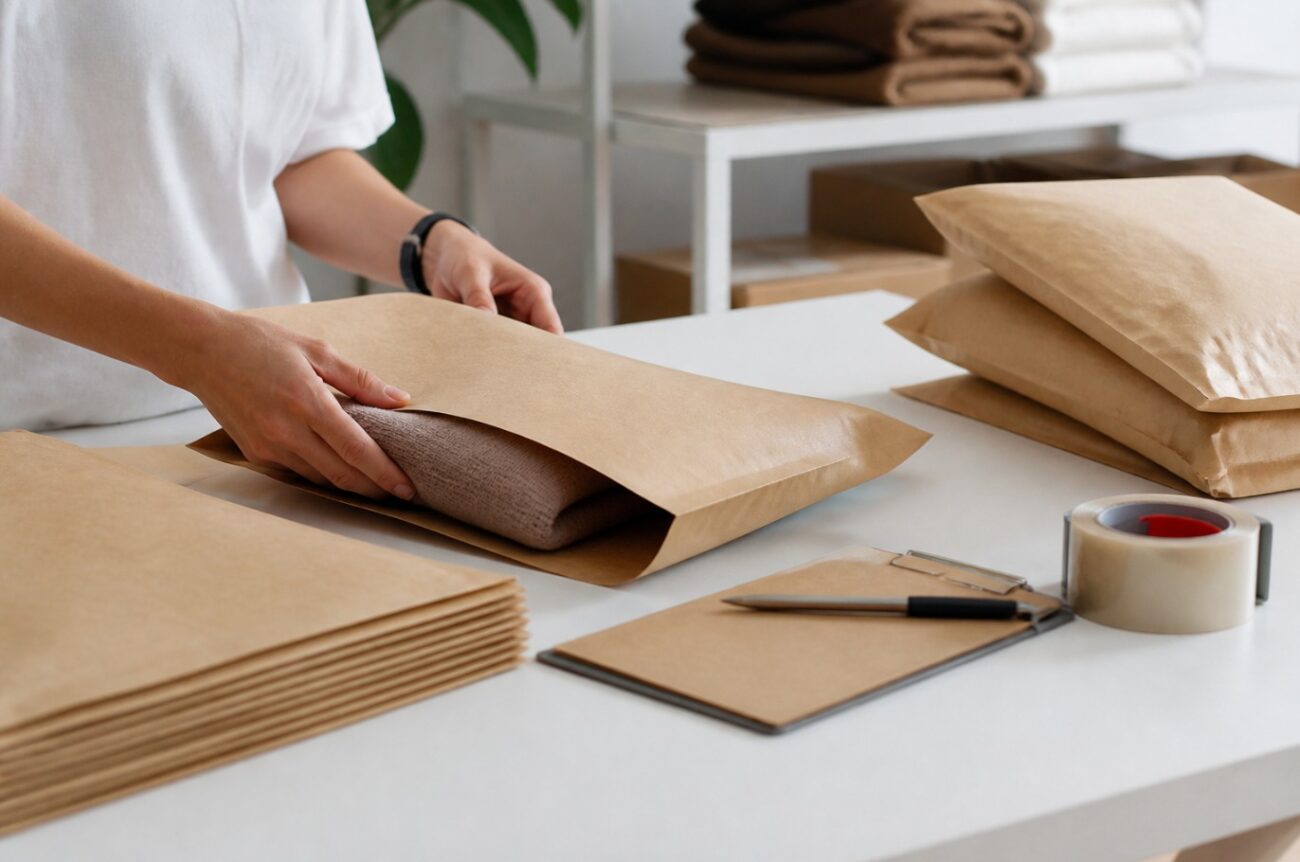
Ship a T-shirt in a box built for hardcover books, and you’ll pay for the empty air inside it. That’s not an exaggeration — it’s exactly how dimensional weight pricing works, and it’s quietly draining margin from apparel sellers who haven’t rethought their packaging in years. Carriers don’t just weigh your package anymore. They measure it, run the numbers, and charge you for whichever figure is higher.
That’s where kraft paper mailers earn their keep. A soft, low-profile mailer that hugs a folded shirt or a pair of leggings simply can’t rack up the dimensional charges a rigid box does. For sellers moving apparel and soft goods, that difference shows up on every single label, every single day.
Here’s what most sellers miss: it’s not just about switching materials. It’s about matching the right mailer format — kraft, gusseted, bubble-lined — to the actual shape of what you’re shipping. Get that wrong, and you’re still overpaying, just with a greener-looking bag.
How Dimensional Weight Pricing Actually Penalizes Bulky Apparel Packaging
Picture a small shop shipping a single cotton hoodie in a 12x10x6 box. The hoodie weighs 14 ounces, but the box is mostly empty space. Every major carrier now bills by dimensional weight, not actual weight — and that empty air gets charged like it’s merchandise. The seller ends up paying for a phantom 4-pound package instead of the real, sub-1-pound item. That’s money burned on nothing. Switching to kraft paper mailers collapses that box down to something close to the product’s actual footprint.
The Math Carriers Use Against Oversized Boxes
Dimensional weight gets calculated as length x width x height divided by a carrier divisor (usually 139 or 166). Run that hoodie box through the formula and it prices out at nearly 5 pounds — over three times its real weight. Do that across 500 monthly orders and the overage adds up fast, quietly eating margin nobody budgeted for.
Where Corrugated Mailer Boxes Still Make Sense
Not everything belongs in a flat mailer, though. Layered apparel, boxed sets, or anything needing rigid protection still calls for corrugated mailer boxes. The rule of thumb: soft goods that can compress go flat; anything structured or gift-boxed stays in a box, dimensional weight cost or not.
Kraft Paper Mailers vs Poly Mailers for Clothing: The Real Cost Comparison
Poly mailers for clothing are lighter, sure — but weight isn’t the whole story. Carriers calculate dimensional weight using length, width, and height, not just what’s on the scale. A flat, well-folded kraft paper mailer can actually beat a stuffed poly mailer for clothing packed loosely. Fold a T-shirt into a 9×6 kraft mailer bag, and it sits under an inch thick — that’s a footprint FedEx charges you fairly for, no penalty for bulk.
Kraft mailer boxes also compress better in transit than a bag stuffed with a hoodie. And here’s what most people miss: paper mailers for clothing hold their shape after sealing, so the box a shipper measures at drop-off matches what actually ships. Poly bags balloon out and get remeasured — sellers eat that difference more often than they realize.
Kraft Bubble Mailers for Fragile Add-Ons
Shipping a shirt with a small accessory — a pin, a keychain, jewelry? Kraft bubble mailers add cushion without adding bulk. They’re not for glass, but for light fragile add-ons, they’re the sweet spot between protection and a slim profile.
Paper Cushion Mailer Options for Mixed Orders
For orders combining apparel and a flatter item, a paper cushion mailer keeps everything protected in one flat unit — no need for corrugated mailer boxes on lighter combined shipments.
Choosing the Right Kraft Mailer Boxes and Bags for Soft Goods
Ever tried stuffing a hoodie into a mailer built for a T-shirt? It rips at the seams — literally. Picking between kraft mailer bags and kraft mailer boxes — corrugated mailer boxes comes down to what you’re actually shipping. A single tee or a scarf survives fine in a standard flat bag. Layered items, sweaters, or anything with structure need more room and a stiffer wall.
Gusseted Kraft Mailers for Bulkier Garments
This is where a lot of small apparel sellers get it wrong. A flat kraft mailer forces you to compress a bulky item, which stresses the seal and invites tears in transit. Gusseted kraft mailers solve that — the expandable sides give jackets, jeans, and multi-item orders actual breathing room without jumping up to a bulkier corrugated mailer box. They still fold flat for storage before use, so you’re not sacrificing shelf space to gain capacity.
Sizing Guidance: Small, Long, and Standard Formats
Match the format to the garment, not the other way around:
- Small — accessories, socks, single tees
- Standard — folded shirts, light layers
- Long — pants, dresses, robes shipped unfolded
Buying wholesale in these three formats covers roughly 90% of apparel orders without overpaying for unused space.
Sourcing Custom Kraft Mailers Wholesale Without Overbuying
Here’s a number that surprises most sellers: minimum order runs for custom kraft mailers wholesale often sit between 500 and 1,000 units — not the 10,000-unit pallets people assume. That changes the math for a small apparel shop testing kraft paper mailers before committing hard. Buy too few and per-unit pricing punishes you. Buy too many, and you’re storing boxes of unused mailer bags in a closet for a year.
What to Check Before Buying Kraft Mailer Boxes Wholesale
Before placing an order, check three things: seam strength (gusseted kraft mailers hold up better under stuffed apparel loads), the peel-and-seal strip quality, and whether the supplier lists actual burst-test numbers instead of vague marketing language. Compare kraft mailer boxes near you against wholesale-only sources — local pickup rarely beats bulk pricing once shipping’s factored in.
Compostable Mailers Wholesale and End-of-Life Considerations
Compostable mailers wholesale sound great on paper (pun intended), but not every kraft mailer bag labeled “eco” actually breaks down in a home compost bin. Look for certification, not just a green color scheme. Ask suppliers directly whether the coating — if any — is compostable or just recyclable. Those are not the same claim, and mixing them up gets brands in trouble with customers who actually try to compost the packaging.
Here’s the honest math: dimensional weight doesn’t care how nice your product looks in a box. It cares about cubic inches. Every seller shipping soft goods eventually has to answer the same question — is this package earning its size, or just padding the carrier’s invoice? Kraft paper mailers answer that question well for a lot of apparel, especially anything that isn’t fragile and doesn’t need rigid corners. They flex to the product instead of forcing the product to fit a fixed shape, and that alone can shave real weight off a shipping bill month after month.
None of this means one mailer type wins every scenario. Gusseted styles handle bulk, bubble-lined versions handle breakables, and standard flat formats still cover most basic clothing runs. The job is matching the mailer to the actual contents, not defaulting to whatever’s already stacked in the storeroom.
So before the next bulk order goes in, pull three recent shipments, measure them against current mailer stock, and check whether the sizing still fits what’s actually being sold. That five-minute audit pays for itself fast.
