The pain most people fear is not the pain most people get — and the part that actually defeats people is not scored on a pain scale at all.
Two narratives dominate this topic. One says the procedure is medieval torture. The other, usually attached to a booking form, says modern internal nails have made it comfortable. Both are wrong in interesting ways, and the gap between them is where you should be making your decision.
Pain Here Comes From Four Separate Places
They arrive on different timelines, respond to different treatments, and mean different things.
- Surgical pain, from the bone cut and nail insertion. Days to a couple of weeks. Predictable, expected, treated conventionally.
- Distraction pain, from separating the bone ends by a fraction of a millimetre several times a day. Weeks to months.
- Soft-tissue pain, from muscles, tendons and fascia being stretched at a pace they did not agree to. This is the physiotherapy pain, and it lasts longest.
- Nerve pain, which is different in character and different in significance.
Lumping these together as “the pain” is why people arrive unprepared. They brace for the operation and get ambushed by month three.
What the Data Actually Says About the Lengthening Phase
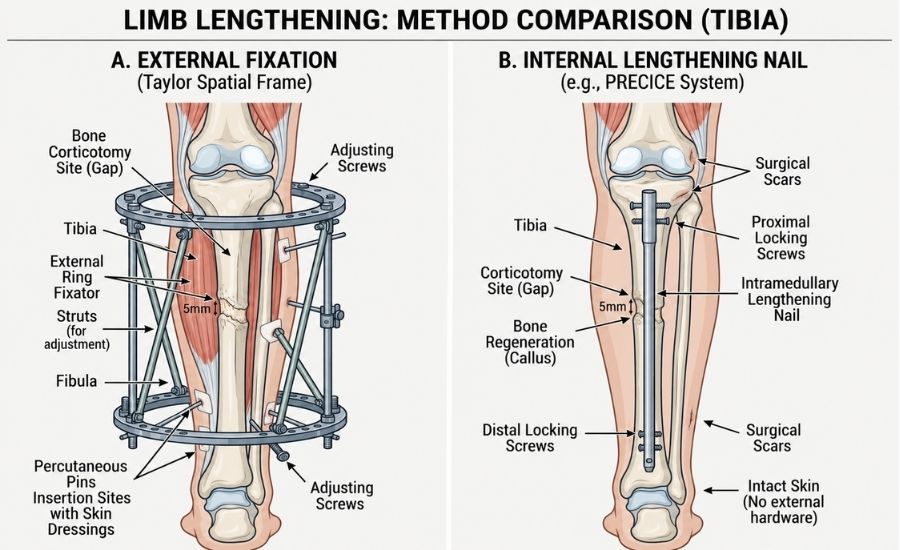
Here is the finding that surprises most people. A study of 168 cases lengthened with internal nails recorded daily pain scores throughout the distraction phase under a standardised medical regime. Average pain on the first postoperative day was under three on a ten-point scale, and it declined steadily to under two across roughly two months of lengthening. The authors concluded that distraction pain was generally low, continuously decreasing, and manageable mostly with non-opioid painkillers. Nail model, bone, side, age and sex made no measurable difference.
That is genuinely reassuring, and it deserves three caveats before you rely on it.
It describes internal nails. External fixators are a different experience — pins passing through skin and muscle produce their own pain and their own infection risk, and that is well documented.
It describes a specialist centre with a standardised protocol. The result is partly a measurement of good pain management, not just of the procedure.
An average conceals individuals. A mean below three means some people were considerably above it.
And most importantly: a daily pain score measures pain. It does not measure stiffness, dependence, sleeplessness, or the grind of a physiotherapy session you have to do whether or not you feel like it.
Physiotherapy Is Where People Say It Actually Hurts
Bone regenerates readily when pulled apart slowly. Muscle, tendon and nerve do not.
Every millimetre of new bone puts your hamstrings, calves, hip flexors and Achilles under tension they will resist by tightening. Left alone, that produces contractures — most commonly the ankle pulling into a pointed position — and joint stiffness that can outlast the lengthening by a long way. The only thing that prevents it is aggressive, daily, uncomfortable stretching and mobilisation, for months.
This is the honest centre of the answer to how painful this is. Not the operation. Not the daily click of the nail. The therapy session, every day, for the better part of a year, at a point when you are tired and your progress feels invisible.
It is also the part where your outcome is decided. Patients who keep up with physiotherapy generally regain function. Patients who do not are the ones describing a permanent problem years later.
Nerve Pain Is a Signal, Not an Inconvenience
Burning, electric or shooting sensations, new numbness, pins and needles, or weakness in a foot are a different category from aching and stretching discomfort. They can indicate a nerve under too much traction.
Report them the same day. The response may be slowing or pausing the lengthening rate, and occasionally a surgical release. This is not something to be stoical about, and any centre that treats it as normal background noise is the wrong centre.
The Duration Is the Real Burden
Lengthening conventionally proceeds at about a millimetre a day, so a gain of six centimetres means roughly two months of daily distraction — and then months of consolidation while the new bone hardens enough to carry you.
A systematic review pooling eleven studies and several hundred patients found a mean gain of around six to seven centimetres, a mean external fixation time of about two hundred days, and an average of close to two treatment-relevant problems, obstacles or complications per patient. The authors also noted that the field still lacks agreed indications, contraindications and guidelines — meaning the assessment of whether you are a suitable candidate is currently being made by the centre selling you the procedure.
Measure this in months, not in pain scores. Restricted mobility, disrupted sleep, dependence on other people for ordinary tasks, and a long stretch out of work are the parts that people describe as hardest, and none of them appear on a rating scale.
What Genuinely Reduces the Pain
- A specialist orthopaedic surgeon doing this regularly, not a general aesthetic practice
- A written analgesia protocol, including how it is managed once you are no longer in the country
- A conservative distraction rate, adjusted downward when soft tissues protest
- Structured, supervised physiotherapy at high frequency — not a leaflet
- Reporting nerve symptoms immediately rather than pushing through
- Realistic targets, since larger gains stretch soft tissue harder
What does not help: enduring it silently, skipping sessions on bad days, or choosing a centre because the trip is shorter.
Pain Is Not the Same as Risk
This is worth separating clearly. Pain is uncomfortable and finite. The things that can genuinely alter your life are nerve injury, joint contracture, non-union or deformity of the new bone, and deep infection — and those are not proportional to how much something hurts. Someone can have a comfortable distraction phase and a poor functional result, or the reverse.
So do not use pain as your risk gauge. Use the surgeon’s complication rates, their case volume, and their plan for the year after you leave.
What This Means for Choosing a Centre
If you are searching for the best limb lengthening surgery in Turkey, the ranking that survives contact with reality is not built from before-and-after photographs. It is built from written answers about pain and physiotherapy, because those are the parts of this procedure that run for months after any package expires.
Ask, in writing:
- Who operates, with what orthopaedic specialty qualification, and how many lengthenings per year?
- What is your analgesia protocol during distraction, and who manages it once I go home?
- How many physiotherapy sessions per week, delivered by whom, for how many months — and where do they happen after I leave?
- What distraction rate do you use, and under what circumstances do you slow it?
- What are your rates of nerve injury, contracture, infection, non-union and revision?
- Is a psychological assessment part of your pathway?
- Who supervises me for the twelve months after the lengthening phase, and what documentation do I take home?
A centre that offers or requires a psychological assessment is working in your interest. One that never mentions it is selling.
The Honest Summary
Is it painful? The lengthening itself is usually more tolerable than the internet suggests, particularly with internal nails at a properly run centre. The physiotherapy is harder than almost anyone expects, and it goes on for the better part of a year. And the hardest element is not pain at all — it is duration, immobility and dependence.
If that description makes the trade sound reasonable to you, you are approaching this with your eyes open. If it does not, that is useful information and it cost you nothing. No search for the best limb lengthening surgery in Turkey or anywhere else will tell you which of those you are; only an honest look at a year of your life will.
This article is general information and not medical advice. Only a qualified orthopaedic surgeon who has examined you and reviewed your imaging can assess whether this procedure is appropriate for you and what your individual risks and recovery would involve. Please discuss your case with a specialist, and consider an independent second opinion, before making any decision.
