
In today’s fast-paced retail and corporate panorama, having unique products or services is half the battle. The other half? Be profitable so the numbers behind your business are as solid as you give them. The Financial Supervisory Authority has developed far beyond proper accounting. It now serves as the strategic backbone that determines whether a company will survive, not just to tell a story. Businesses that treat their value chain as a reactive feature rather than a dynamic growth lever often struggle to scale, while those that manage profits aggressively can replicate this.
The modern entrepreneur wears limitless hats, from advertising and marketing guru to product visionary. Yet from an economic perspective, “pretty much” means that managers are tempted to do everything themselves or relegate it to an overloaded internal team. This technique often leads to missed opportunities, risk of slipping currency, and high-value mistakes. Outsourced Accounting Services provide businesses with access to dedicated financial expertise, helping them break through these limitations and receive the advanced support they need.
A strategic shift from accounting to financial intelligence
Gone are the days when financial control was really about recording transactions and balancing checkbooks. Today, forward-looking companies see their economic data as a treasure trove of actionable insights that can tell a great deal, from pricing techniques to market growth plans. This evolution moves from intellectual reporting to forward-looking estimation, which, when made a central element, can increase organizational financial agility.
- The real difference lies in interpretation and technique.
- Raw numbers tell a story, yet quality business professionals can translate that story directly into a roadmap for growth.
- Here, the intensity of the plates honestly comes into play.
A nicely groomed economic escort will not only tell you what happened to the comfort of the arena; they will help you understand why this happened and, more importantly, what to do about it going forward. They can spot symptoms of issues before they end, spot inefficiencies that drive sales, and advocate for investments that deliver better returns. This assumption transforms finance from foreign money itself into a revenue driver.
Creating incentives for scalable growth
As companies get bigger, they want to expand the form of economics they have. What might seem cumbersome for a small startup with a handful of transactions is unacceptable for a growing business with two revenue streams, two payment titles, and complex compliance requirements. Scaling without a strong financial framework is like building a cloud of sand. Having scalable structures in place upfront is often not realistic; this is extremely important for long-term sustainability and investor confidence.
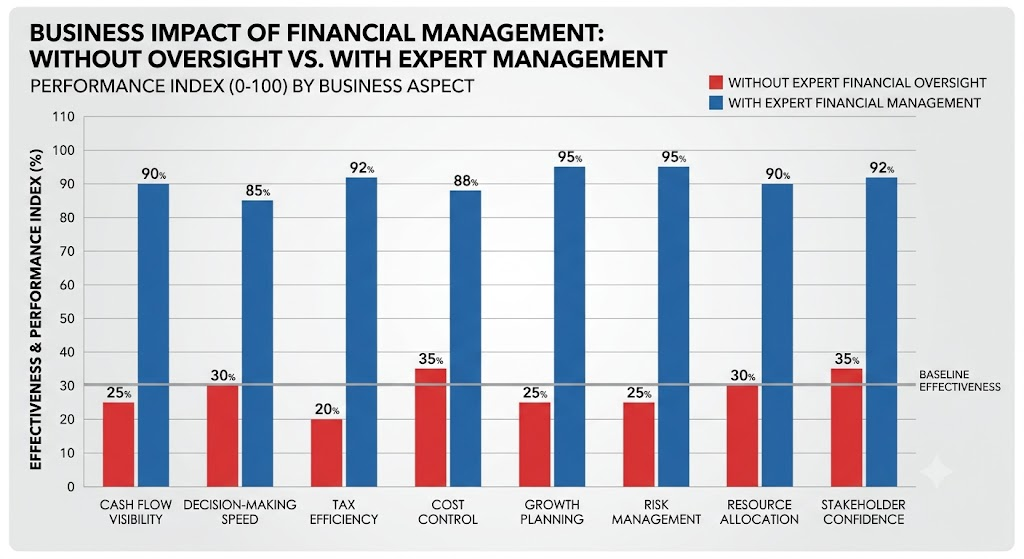
| Business Aspect | Without Expert Financial Oversight | With Expert Financial Management |
| Cash Flow Visibility | Limited visibility; reactive crisis management | Real-time monitoring with predictive forecasting |
| Decision-Making Speed | Slower; relies on outdated data or gut feeling | Faster; backed by timely, accurate financial intelligence |
| Tax Efficiency | Frequent missed deductions and compliance risks | Strategic tax planning with maximized savings |
| Cost Control | Unchecked spending and hidden inefficiencies | Proactive cost optimization and regular reviews |
| Growth Planning | Uncertain; lacks financial roadmaps for expansion | Data-driven with clear budgets and investment strategies |
| Risk Management | Reactive; crises are handled after they occur | Proactive; risks identified and mitigated early |
| Resource Allocation | Often inefficient; decisions based on incomplete info | Optimized, every dollar directed toward the highest ROI |
| Stakeholder Confidence | Limited trust; financial opacity | High trust; transparency and accurate reporting |
| Scalability Readiness | Struggles to handle increased complexity | Scales smoothly with adaptable financial systems |
- Effective economic management at scale requires a blend of technology, methodology, and human understanding.
- Automation can handle repetitive responsibilities with speed and accuracy, freeing up valuable time for strategic work.
- But automation itself is the product of years of effort. Cannot replace the nuanced decisions that come.
- Most successful agencies strike a careful balance to utilize digital systems and place considerable human oversight on manually complex economic choices.
- This dual approach ensures efficiency and reliability, fostering a monetary environment that facilitates aggressive yet sustainable treatment.
Acquiring top-notch knowledge without the upper
An overwhelming obstacle to public financial manipulation has historically been cost. Hiring a full-time CFO or having a large in-house accounting department requires significant funding of salaries, benefits, training, and overhead. For many medium-sized companies or perhaps some larger groups, this fee is clearly not affordable or sustainable. However, the need for highly phased financial guidance does not completely disappear now that the company cannot fund a permanent supervisory team. This paradox created the name “Bendy,” the available answer that provides on-demand knowledge.
Here, the concept of using external experts has gained tremendous traction. By hiring outsourced accountants, companies can take advantage of access to the same high-quality economic knowledge as their leading competitors without the associated typical fees. These experts offer a wealth of expertise across specific industries and business models. The shift to timely advice alone cannot make way. Business, so that companies can respond quickly to changing seasonal conditions.
Technological Advantage in Modern Financial Operations
Technology has revolutionized almost everything. Business operations and finance are no exception. Cloud-first accounting systems, AI-powered analytics, and real-time reporting tools have made it possible to monitor financial health with unprecedented readability and speed. Decision-makers don’t have to wait for monthly or quarterly assessments to take their place. Early access to the right metrics can provide urgent dashboard choices, capturing opportunities and mitigating risk before it escalates.
But access to effective tools is the easy half of the equation. The real magic happens when that time is paired with company professionals who know how to interpret information and use it strategically. This is where an outsourced account services team proves valuable. These salespeople do not come with perfect technical skills but, in addition, OK practices gathered from different customer service experiences. They can identify structures for precise company needs, train internal workforces in new ways, and ensure financial data is consistently accurate and consistent.

Reduce randomness and ensure compliance.
The regulatory environment for companies has become increasingly complex; tax rules, reporting requirements, and business-specific regulations are constantly evolving. Compliance is mandatory. Failure to comply with responsibilities can result in severe penalties, complaints, and reputational damage. In addition, crises extend pre-existing regulatory problems into fraud, statistical breakdowns, and operational inefficiencies that can derail even the most promising companies. A proactive approach to threat management is also critical to ensuring the long-term stability of defense assets.
- Expert money management presents a critical layer of security against those threats. Professionals who live simultaneously with regulatory integration can confidently help companies navigate complex requirements.
- They implement internal controls that protect against fraud and errors, daily audits to be aware of vulnerabilities, and detailed remediation plans for capability changes.
- This complete approach to threat monitoring does more than just protect against problems; it creates a culture of transparency and security throughout.
- When economic control is viewed through the lens of harm reduction, its value extends far beyond the balance sheet.
Final Thoughts
The role of economic management in developing additional powerful business public performance cannot be overstated. This thread weaves itself into every issue of business activity, often influencing choices in hiring, expansion, pricing, and innovation. Companies that treat finance as a strategic companion in a truly adverse situation are setting themselves up for continued success in an increasingly competitive market. Given the name of the game, advanced economic management is not always a luxury reserved for large groups; it is by far a tangible advantage that any company can achieve with the right strategies.
Embracing modern farming systems, leveraging time, and accessing advantageous business operations isn’t just smart business – it’s critical to survival and growth. The organizations that can move in the right direction to run their industries in the coming years are those that have built strong economic foundations these days.
FAQs
1. How can a small business achieve superior economic understanding without a large price range?
Many smaller companies find this by using attractive outside professionals who provide flexible, scalable services. This method provides access to skilled experts without the everyday expense of full-time employees, making top-level financial operations cheap and easy.
2. What are the signs that my company wants better financial management?
Common signs and symptoms include cash flow issues, difficulty tracking payments appropriately, missed tax deadlines, lack of well-timed financial reports, uncertainty, and suppressed profitability. If you discover that you are making choices without clean financial data, it is time to improve your financial management process.
3. How does technology increase cash control for businesses?
Technology streamlines repetitive responsibilities like recording and reconciling transactions, provides real-time visibility into financial metrics, and enables sophisticated assessments that identify trends and opportunities; when blended with human expertise, these tools dramatically increase performance and selection.
4. Are there risks in outsourcing financial capabilities to external airlines?
When outsourcing is carefully managed with legitimate carriers, it can certainly reduce the risk. Professional firms bring expert knowledge, implement strong internal controls, and ensure regulatory compliance. Selection of partners with established due diligence processes and clear conservation protocols is essential.
5. How often does a business need to review its revenue policy?
The financial model should be reviewed at least quarterly, with key figures monitored more frequently. However, key strategic choices or massive market changes may also require on-site evaluation. Regular reviews ensure that budgets remain aligned with corporate business dreams and evolving goals.
