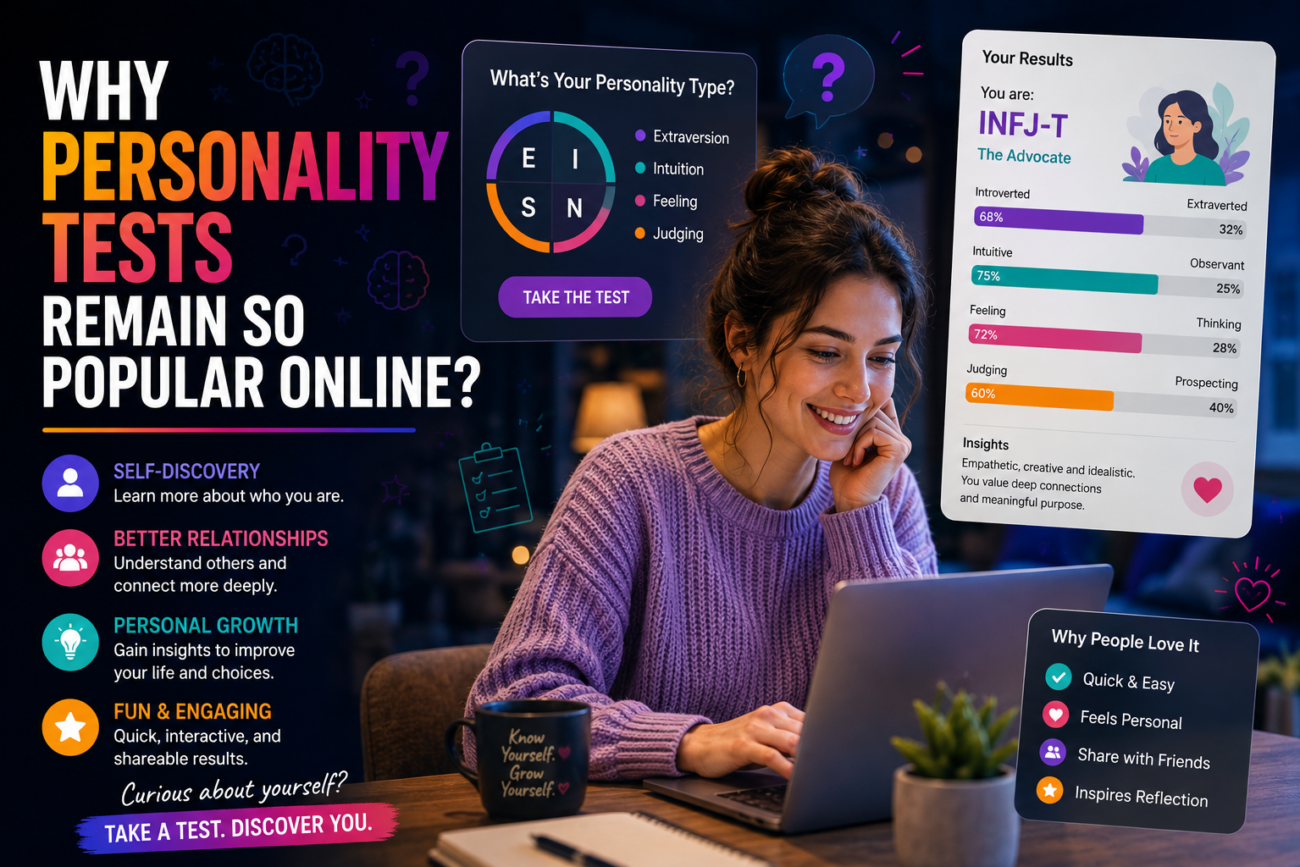
Personality tests have managed to survive almost every major change in the internet. They were popular when people shared quiz results through early social networks, remained common as social media feeds evolved, and continue to attract attention in an age dominated by short-form video and interactive content.
Part of the appeal is simple curiosity.
People naturally want to know more about themselves. They wonder how their personality compares with others, whether certain habits reveal something about their character, or how they might respond in different situations.
An online test provides an easy way to explore those questions.
The experience usually takes only a few minutes. A person answers a series of questions, receives a result and then decides what to make of it. Sometimes the result is surprisingly accurate. Sometimes it is amusingly wrong. Either way, the process gives people something to think about.
That combination of curiosity, entertainment and self-reflection helps explain why free online personality tests continue to attract users.
Curiosity Is the Starting Point
Human beings are naturally curious about themselves.
We spend a considerable amount of time thinking about our preferences, habits, relationships and decisions. Yet it can be difficult to step outside our normal routines and look at those patterns objectively.
Personality-style tests create a simple opportunity to do that.
A question such as whether someone prefers planning everything in advance or making decisions spontaneously may seem straightforward. But answering it can make a person consider their behavior more closely.
The result then gives them another perspective to consider.
The test does not necessarily reveal a hidden truth. Instead, it provides a framework for thinking about something that people already find interesting: themselves.
That is often enough to make the experience enjoyable.
Why People Enjoy Seeing a Result
There is a natural sense of anticipation that comes from completing a test.
You answer one question after another without knowing exactly what the final result will say. Once the questions are finished, the result provides a conclusion.
Even when the test is designed primarily for entertainment, that moment can be satisfying.
People want to know:
What did I get?
The result can also provide a starting point for further thought.
Someone might read a description and immediately recognize certain habits. Another person may disagree with it completely. Both reactions can lead to reflection.
A result that feels accurate can prompt recognition.
A result that feels inaccurate can prompt someone to ask why they disagree.
In that sense, even a lightweight quiz can create a more active experience than simply reading an article.
Personality Tests Turn Reading Into Participation
Traditional online content generally asks users to read, watch or listen.
Interactive tests ask them to do something.
The user has to choose answers. Their decisions influence what appears at the end. That small amount of participation can make the experience feel more personal.
Compare reading a list titled “Signs You Are an Introvert” with answering a series of questions about social situations and receiving a result.
The first is informational.
The second is interactive.
Both can be interesting, but the second creates a stronger sense that the user is involved in producing the outcome.
This is one reason interactive content has remained effective even as online attention patterns have changed.
The Social Side of Personality Quizzes
Personality tests become even more interesting when people compare their results.
A quiz may be completed alone, but the result does not have to remain private.
Friends can compare answers.
Partners can discuss differences.
Family members can joke about unexpected results.
Online communities can debate whether a particular description actually fits them.
This social element adds another layer to the experience.
Imagine two friends taking the same personality quiz. One receives a result suggesting they are highly organized, while the other gets a description associated with spontaneity.
The results immediately create a conversation.
“That’s definitely you.”
“No, that doesn’t sound like me at all.”
“You always plan everything.”
“I only do that because you never plan anything.”
The test itself may take five minutes, but the conversation afterward can last much longer.
Self-Reflection Without Making It Too Serious
Not every personality test needs to be treated as a serious psychological assessment.
In fact, much of the appeal comes from keeping the experience light.
People can explore questions about habits, preferences and behavior without feeling that they are taking part in a formal evaluation.
This makes online personality content accessible.
Someone who would never sit down to read a lengthy psychology book may happily answer twenty questions about how they approach social situations.
The experience can encourage reflection without requiring a major time commitment.
However, it is important to keep expectations realistic. Entertainment-oriented personality quizzes should not automatically be treated as scientific psychological assessments or professional evaluations.
Their value often comes from curiosity and conversation rather than clinical accuracy.
Personality Tests Encourage People to Think About Their Behavior
One of the most interesting aspects of a personality-style test is the way questions can make ordinary behavior noticeable.
Consider a question about how someone responds when plans suddenly change.
A person might immediately choose the option describing frustration and a desire to regain control.
That answer may seem obvious, but it can also prompt a second thought:
Why does that bother me so much?
Similarly, a question about conflict might make someone consider whether they tend to confront problems directly, avoid them or wait until emotions settle.
The test does not need to provide a definitive explanation.
Sometimes asking the question is valuable enough.
People Like Comparing Results
Comparison is another major reason quizzes spread online.
When people receive a result, one of their first instincts may be to see what someone else received.
Are we similar?
Are we completely different?
Who is more outgoing?
Who is more cautious?
Who handles pressure differently?
These questions turn an individual activity into a social one.
The same principle explains why people enjoy comparing scores in games, preferences in recommendation tools and results from various interactive challenges.
Comparison provides context.
A result becomes more interesting when there is another result beside it.
Personality Tests Work Well With Social Media
Social platforms are naturally suited to interactive content because users can share their experiences with other people.
A test result can become a conversation starter.
Someone might post that they received an unexpected personality type and ask whether others agree. Another person might comment with their own result. A third might explain that they received a completely different outcome.
The content becomes less about the test itself and more about the discussion around it.
This is particularly interesting for social platforms that combine interactive features with user-generated conversations.
Instead of completing a quiz and leaving, users can continue exploring what their result means to them and how other people responded.
Different Types of Personality Tests Appeal to Different People
“Personality test” is a broad category.
Some tests focus on general personality characteristics. Others explore communication styles, decision-making preferences, social habits or reactions to everyday situations.
Some are humorous.
Others are designed to encourage more serious reflection.
The variety helps keep the format fresh.
A person may not be interested in one quiz but become curious about another because the subject feels more relevant to their life.
For example, someone interested in personal development may enjoy questions about habits and decision-making. Someone who simply wants entertainment may prefer a playful test based on fictional scenarios.
The format stays familiar while the subject changes.
Why Short Tests Fit Modern Online Habits
Attention online is often fragmented.
People may have a few minutes while waiting for an appointment, taking a break from work or commuting.
A long article can require more commitment than they want to give at that moment.
A short interactive test fits more easily into those gaps.
The user can complete it quickly and receive an immediate result.
This does not mean people have lost interest in long-form content. It simply means interactive formats offer another way to engage.
The combination of short time commitment and personalized results is particularly well suited to casual browsing.
The Appeal of “What Kind of Person Am I?”
At a deeper level, personality tests connect with a much broader human question:
How would I describe myself?
Identity is complicated.
People can be confident in one situation and uncertain in another. They may be highly social with friends but quiet around strangers. They may enjoy planning holidays but make spontaneous decisions in other areas.
A simple category cannot capture everything about a person.
But categories can still be useful for starting conversations about those differences.
A personality quiz gives people labels, descriptions or scenarios that they can compare against their own experiences.
Sometimes the result feels familiar.
Sometimes it feels incomplete.
Sometimes it simply makes them laugh.
All three reactions can be part of the appeal.
Results Can Become Conversation Starters
An interesting test result does not have to end with the result page.
It can lead to questions such as:
- Do you agree with your result?
- Did your friends get something similar?
- Which part of the description sounds most accurate?
- Was there anything you completely disagreed with?
- Did your answers change when you took the test again?
- What would you have expected the result to be?
These questions shift the focus from the quiz to the people taking it.
That is where interactive content becomes particularly useful for social platforms.
The test creates an easy reason to start talking.
Conflingo and Interactive Personality Content
Conflingo includes free online personality tests as one of the interactive features available within its broader social media platform.
That distinction matters.
Conflingo is not primarily a personality testing website. Its wider experience is centered on social interaction, conversations, opinions, shared interests and discovering other users.
The tests are one additional way for people to interact with content.
A user can explore a personality-style test out of curiosity, think about the result and potentially use it as a starting point for conversation with others.
This combination reflects a broader trend in online communities: interactive features can give people more ways to participate instead of simply scrolling through content.
Entertainment Is Part of the Value
There is sometimes pressure to find a practical purpose for everything people do online.
Not every quiz needs to improve someone’s career.
Not every personality test needs to produce a profound psychological insight.
Sometimes people simply want to have fun.
Entertainment is a legitimate reason to participate.
A playful test can provide a few minutes of amusement during a break. Comparing results with friends can create a joke that continues throughout the day. An unexpected result can simply be something interesting to share.
The lightweight nature of these experiences is part of what makes them accessible.
But Results Should Be Taken With Perspective
The popularity of personality tests does not mean every result should be treated as an objective description of someone’s identity.
Online tests vary considerably in how they are created and what they measure.
Some are carefully designed around established concepts. Others are primarily entertainment.
That means users should approach results with curiosity rather than certainty.
A result can encourage self-reflection without becoming a permanent label.
People are more complicated than a handful of multiple-choice answers.
Personality also develops through experiences, circumstances and relationships. A person may behave differently at different stages of life or in different environments.
The most useful approach is often to ask, “Does this give me something interesting to think about?” rather than “Is this exactly who I am?”
Why The Format Is Likely to Continue
Personality tests have several qualities that work particularly well online.
They are easy to understand.
They require active participation.
They provide an immediate outcome.
They encourage comparison.
They can be entertaining.
They can prompt self-reflection.
And they are easy to discuss with other people.
That combination makes the format remarkably adaptable.
As websites and social platforms continue developing new interactive features, personality quizzes can evolve with them.
They may become more visually engaging, more personalized or more closely integrated with community features.
The basic appeal, however, is unlikely to change.
People will remain curious about themselves.
Personality Tests as a Gateway to Broader Interaction
Perhaps the most interesting possibility is that a test can be more than an isolated activity.
A person may arrive because they want to answer a few questions.
They may stay because they discover a discussion related to their result.
They may comment on someone else’s perspective.
They may find people with similar interests.
The interactive feature becomes an entry point into a broader social experience.
This is particularly relevant for platforms that are designed around participation rather than treating every feature as a separate destination.
The test gives users something immediate to do.
The community gives them somewhere to take the experience next.
Final Thoughts
Personality tests remain popular online because they combine several things people naturally enjoy: curiosity, self-reflection, comparison, entertainment and social interaction.
They are simple enough to complete in a few minutes but open-ended enough to generate conversations afterward.
A result can make someone laugh, confirm something they already suspected or encourage them to think about a familiar behavior from another perspective.
The important thing is to treat entertainment-oriented tests as opportunities for curiosity rather than definitive judgments about personality.
Platforms such as Conflingo show how these interactive experiences can exist alongside a much broader social environment. Its free online personality tests are one feature within a platform where people can also participate in conversations, discover others and interact around shared interests.
The lasting appeal of personality quizzes ultimately comes down to a simple idea: people are curious about who they are, and they enjoy finding out how their answers compare with everyone else.
