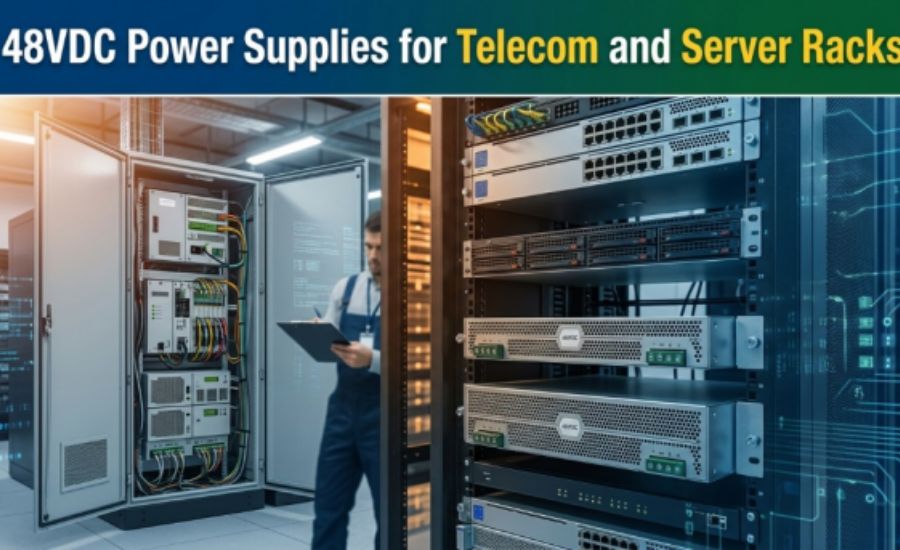
Telecommunication systems serve as the backbone of global connectivity, enabling voice, video, data, and internet services worldwide. This vast network requires a significant amount of power to operate continuously without any interruption. The need for immense power depends on various operational demands, including equipment requirements, redundancy, and environmental challenges. Here, a 48VDC power supply is preferred. The consideration results after evaluating the unique needs and challenges of the telecommunication infrastructure.
The adoption of 48VDC power systems has a long and well-established history. It was used back in the 20th century when the use of telephones was first initiated, and later expanded. Early telephone exchanges required a reliable and stable power source to operate analog switching equipment, which enabled long-distance communication.
Initially, telephone systems operated using manual switchboards powered by batteries. Later in the early 1900s, the industry standardized on 48VDC, driven by a combination of factors, including safety, efficient power delivery, and lower transmission losses. Afterwards, it evolved with the telecom industry from analog to digital, copper to fibre, and now it has shaped itself into wireless and cloud technologies. From the early days of telecommunication to the postmodern era, the use of 48VDC has been paramount.
What is a 48VDC Power Supply?
A 48VDC is an electrical device or system that converts the input power, commonly from an AC main (120V/220V) or higher-voltage DC, into stable 48 volts of direct current (DC) output. This output voltage is specifically designed to power various industrial equipment.
Why 48VDC?
The adoption of 48VDC power supply as an industry standard is not without practical reasons. It is a result of a balance between engineering practicality, safety considerations, operational efficiency, and historical precedent. Many other factors also contribute to its status as a standard in the industry.
1. Touch-safe voltage:
48VDC operates below the 60V safety threshold, meaning it poses minimal risk of electric shock under normal dry conditions.
2. Efficient Power Delivery with Low Losses:
At voltages lower than 48V (such as 12V or 24V), more current is required to deliver the same amount of power, resulting in significant resistive losses over distance. 48VDC preserves the current flow for the same power, allowing for longer cable runs and thinner conductors without substantial voltage drops or overheating.
3. Perfect Compatibility with Battery Backup:
Another reason for the adoption of telecom is its uninterrupted integration with battery backup systems. It simplifies backup by providing instant failover during outages and eliminates the need for AC-to-DC conversion during power switchover.
4. Historical Momentum and Standardization:
The Bell System in the U.S and global telecom organizations standardized on 48VDC in the early 20th century. Once widely adopted, manufacturers designed equipment around this standard, creating an ecosystem of devices, including rectifiers, batteries, distribution panels, and network gear, that all operate at 48V DC.
5. Simplicity and Reliability:
DC power is simpler than AC power in terms of backup and distribution. In the telecom industry, where uptime is critical, the simplicity of DC-powered systems backed by batteries is highly beneficial.
Technical Benefits:
Direct current systems have become the standard in the telecom industry for several reasons. Understanding the technical advantages and the polarity difference will help you learn the rationale behind this industry practice.
1. Compatibility:
The use of 48VDC ensures compatibility between various telecom equipment and devices. It enables the seamless integration of routers, switches, base stations, and other network components from multiple manufacturers. Standardizing the voltage eventually simplifies network design, deployment, and maintenance.
2. Improved Safety Measures:
Direct Current systems, such as 48VDC, are safer than alternating current systems. During any short circuit, DC systems offer a lower risk of electric shock and arc formation.
3. Battery Backup:
It can easily be powered with any standard 48VDC battery available on the market.
4. Efficiency in Energy Conversion:
The primary function is to convert high-voltage AC (110/220V) from the utility grid into 48VDC. It enhances the energy conversion by streamlining the conversion of incoming power into usable DC voltage with minimal loss. It lowers cable losses and simplifies battery backup.
5. Seamless Integration with Backup Systems:
A 48DVC power supply system directly integrates with battery storage and eliminates the need for an inverter-based AC UPS. It improves efficiency during power outages because the system draws DC directly from batteries. It avoids an AC-DC-AC double conversion loss.
Types of 48VDC Power Supply Units:
The main types of 48VDC power supply are listed below.
1. Rack-mount 48VDC Power Supplies
2. Modular 48VDC Power Systems
3. Standalone 48VDC Power Supplies
4. Hot-Swappable Redundant Power Supplies
5. Outdoor or Weatherproof 48VDC Power Systems
6. DIN Rail Mounted 48VDC Power Supplies
Here is a summary of each type on the basis of application and key features.
| Type | Key Applications | Key Features |
| Rack-Mount | Data centers, telecom, server racks | Compact, modular, rack-fit |
| Modular Power Systems | Scalable telecom and data infrastructure | Expandable, hot-swappable, redundant |
| Standalone Industrial Units | Remote sites, automation, signaling | Rugged, enclosed, standalone |
| Hot-Swappable Redundant Units | Mission-critical networks | Zero-downtime maintenance, N+1/N+2 redundancy |
| Outdoor/Weatherproof | Outdoor telecom, solar, and remote monitoring | IP-rated, thermal control |
| DIN Rail Mounted | Industrial control panels | Compact, DIN mount, easy installation |
| Battery Charger Power Supplies | Telecom backup, remote equipment | Load + battery charging, integrated management |
| Renewable Energy-Compatible | Off-grid telecom, IoT, disaster recovery | Solar/wind ready, MPPT, battery integration |
Applications in Telecom and Server Racks:
The main applications of 48VDC server rack batteries include:
- Data Centers: They provide seamless backup for servers, storage, and networking
- Telecom: They supply power for base stations, remote nodes, and 5G infrastructure
- Edge Computing: Reliable energy for distributed IT at the network edge.
- Industrial Automation: They offer backup for PLCs, robotics, and control systems.
- Renewable Integration: They help buffer solar and wind power, smoothing grid fluctuations.
Key Considerations When Choosing a 48VDC Power Supply:
When choosing a 48VDC power supply, it’s important to match it to your application’s electrical, environmental, and regulatory requirements. Here are the key considerations:
1. Output Power Requirements:
Before choosing a power supply, determine the total power your equipment needs, which includes the peak loads, to ensure the power supply can handle the demand.
2. Output Voltage Regulation:
48V is a standard DC voltage, but it is essential to verify that all the connected devices are compatible with this voltage.
3. Energy Efficiency and Green Power:
High energy efficiency causes less energy loss as heat and improves performance, and also reduces energy cost.
4. Reliability and Redundancy:
Redundant power supplies (N+1 or 2N) to ensure continuous operation even if one power supply fails. Moreover, hot-swappable components like power supplies and batteries can be replaced without interrupting service. Select a system with robust monitoring capabilities to detect and alert you to potential issues.
5. Additional Components:
Moreover, you need to consider the form factor, efficiency, amperage, and the cables required for optimal performance. After considering all these major points, you can choose a power supply that meets the power requirements of your organization, as it has a huge impact on the efficiency of
Conclusion:
The transition towards 48VDC power supply is more than just a trend it’s a strategic move towards higher efficiency, greater scalability, and improved sustainability for modern industries. It is especially beneficial for data centers and telecommunication infrastructure. Server Tech provides reliable 48VDC power solutions designed to support efficient, scalable, and high-performance IT infrastructure.
With the increase in the power demand, interconnectedness, and digitalisation of the system, the role of the 48VDC is also becoming central. Now is the time to reconsider power architecture, and 48VDC is the best for consideration.
FAQs:
1. Why is 48VDC commonly used in telecom and server racks?
48VDC is the industry standard because it provides efficient power distribution, reduces energy loss, and improves reliability for critical telecom and data center equipment.
2. What equipment can a 48VDC power supply support?
A 48VDC power supply can power telecom switches, routers, network equipment, servers, fiber optic systems, wireless base stations, and other rack-mounted devices.
3. How do I choose the right 48VDC power supply?
Choose a power supply based on your total power requirements, output current, redundancy needs, efficiency, safety certifications, and compatibility with your telecom or server rack equipment.
Bless Insight is dedicated to exploring the lives, journeys, and achievements of influential people, offering readers inspiration and valuable life lessons.
